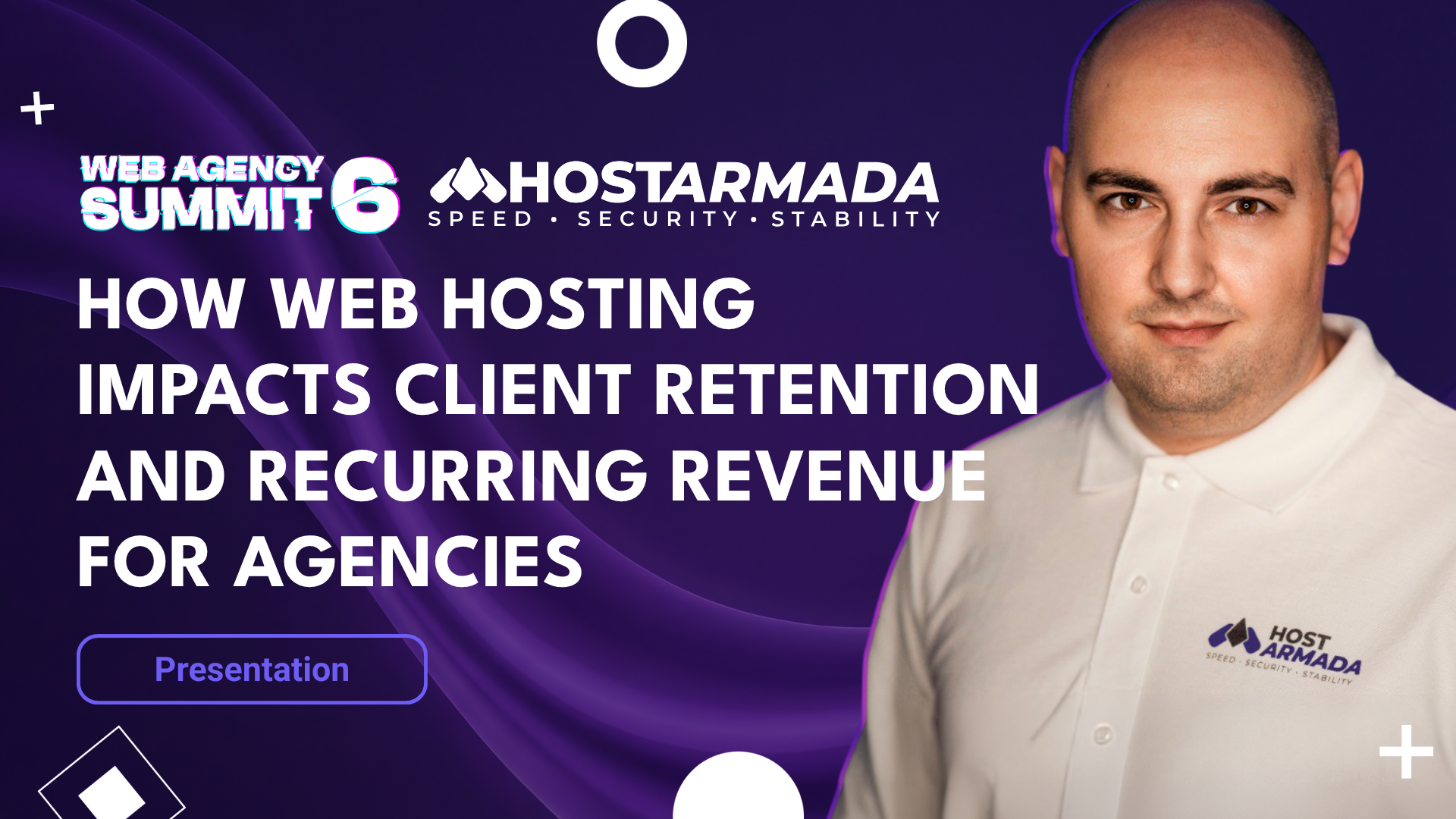
Simeon Mitev, co-founder of web hosting company HostArmada, presents a counterintuitive argument: the most common reason agencies lose clients is not poor design, missed deadlines, or pricing disputes — it is the slow erosion of trust caused by unpredictable website performance. That erosion is frequently rooted in how web hosting is handled (or mishandled) inside the agency's service model.
Mitev frames this not as a sales pitch for hosting services, but as a service design conversation. He identifies three models agencies use to approach hosting — responsibility without control, value without meaning, and intentional control — and argues that the third model is the only one that simultaneously protects client retention and supports defensible recurring revenue. He closes with a four-step framework agencies can begin implementing immediately to shift from reactive service delivery to intentional, consistently defined service.
Key takeaways
- 01A hosting outage lasting as few as 10 minutes can destroy a high-stakes client moment (a pitch, a conference demo, an investor meeting) and turn a technical incident into a trust crisis.
- 02Web hosting is invisible when it works and all-consuming when it breaks — agencies that ignore this dynamic are setting themselves up for client churn they cannot easily explain.
- 03Most agencies fall into one of three hosting models, only one of which — intentional control — positions hosting as a strategic differentiator rather than a liability or a silent inclusion. "Intentional control" does not mean owning servers or becoming a hosting company. It means being deliberate about which hosting environment clients are on, how it is managed, and how that stability is communicated.
- 04The key question is not "do you own the infrastructure?" but "do you control the experience?"
- 05Agencies consistently underprice maintenance retainers because the value inside them is real but vaguely defined — clients who cannot see why the service is worth it will not defend it when budgets tighten.
- 06Standardizing the hosting environment across clients creates compounding benefits: faster diagnosis, more predictable performance, and reduced time spent troubleshooting from scratch.
- 07Defining the service more clearly — for both internal delivery and client-facing communication — does more for retention and revenue than adding new service lines or redesigning packages.
- 08Client churn is rarely caused by a single dramatic event. It accumulates from repeated friction, inconsistency, and small trust breakdowns over time, many of which trace back to hosting instability.
The Central Problem: Hosting as a Trust Variable
The Question Agencies Should Be Asking Mitev opens the session by asking the audience a pointed question: have you ever had a client message you saying "our website is down," "our website is slow," or "our website might be hacked"? He follows this with an even more pointed question: in how many of those situations was the agency actually the party responsible for the issue?
The implicit answer — that the agency often gets blamed regardless — sets up the core argument of the entire talk.
A Real-World Example from HostArmada To ground this in concrete terms, Mitev describes an incident that occurred at HostArmada.
One of the company's larger agency partners experienced an outage in one of HostArmada's data centers. Hundreds of websites hosted on that agency's account were affected.
From HostArmada's perspective, the outage was minor — it lasted no more than approximately 10 minutes. But the agency received an urgent support ticket almost immediately, not because the downtime was technically catastrophic, but because one of the agency's clients happened to be presenting their website at a conference at that exact moment. That same client was also about to use the website in a conversation with a potential investor.
The client entered that investor conversation without a working website.
Suddenly, a 10-minute technical event became a conversation about trust, about agency credibility, and about a missed business opportunity. All of that pressure landed on the agency — not on HostArmada — because the agency was the visible partner in the client relationship. HostArmada had no direct communication with the end client at all.
The Uncomfortable Truth About Uptime Mitev acknowledges what most hosting providers are reluctant to say openly: no provider can actually guarantee 100% uptime in practice. The 99.9% or 100% uptime figures commonly advertised are aspirational targets, not technical guarantees. In reality, hardware
failures, traffic spikes, network incidents, and other unexpected edge cases are always possible, regardless of the quality of the infrastructure.
The implication for agencies is significant: if hosting instability is an inevitability (however rare), agencies that have ceded control over their clients' hosting environments have no buffer. When an incident happens, they have no way to manage the experience — they are simply the recipient of the complaint.
Why the Agency Always Gets the Call Mitev articulates a pattern that HostArmada observes repeatedly: a technical issue becomes a relationship issue for the agency. And the mechanism behind this is simple — clients do not separate web hosting from the broader service the agency delivers.
From a client's perspective, the agency delivered "the website." Everything that touches the website — the design, the performance, the availability, the security — is the agency's domain. Clients are not thinking about data centers, shared hosting plans, or server configurations. They are thinking about whether the thing the agency built and maintains is working.
When a website is slow, clients think the agency is failing to maintain it. When a website goes down, clients think the agency has dropped the ball. When a website is hacked, clients think the agency left them exposed. None of this requires a formal assignment of blame — it is simply the default attribution model clients use.
Why Agencies Underinvest in Hosting as a Service Component
Mitev identifies reasons agencies tend to exclude hosting from their core service offer or monthly maintenance plans.
Hosting Gets No Credit When It Works The primary reason is simple human psychology. When a website is fast, available, and secure, nobody mentions the hosting. Clients take it for granted. They do not send thank-you emails praising server response times. They do not notice a 99.9% uptime record. The positive performance is invisible.
Mitev uses an elevator analogy to make this concrete. An elevator that works perfectly is not something anyone in the office thinks about. You step in, press a button, reach your floor, and continue your day. The elevator is completely absent from your conscious experience.
But the moment the elevator stops working, it becomes the only thing you think about. You are late. You are frustrated. The invisible system has become the entire problem — and it stays the problem until it is fixed.
Hosting behaves identically. Its best performance is total invisibility. Its failure is total visibility. This dynamic makes hosting feel like a poor candidate for inclusion in a service
offer, because there is no apparent credit to be earned when it goes well. The cost-benefit calculation looks backwards to many agencies.
The Accountability Risk A second deterrent for agencies is the accountability risk of including hosting. If an agency is hosting clients' sites and something goes wrong, they are unambiguously in the frame.
Keeping hosting at arm's length — letting clients choose their own providers — appears to reduce that exposure. Mitev later dismantles this assumption entirely, arguing that responsibility already exists whether or not the agency controls the environment.
Hosting Feels Like Infrastructure, Not Service A third deterrent is the mental model most agencies hold: hosting is infrastructure. It is a commodity purchased from a third party, not a service designed and delivered by an agency.
Including it in a service offer feels incongruous — like a contractor listing "building permits" as one of their differentiating services. Mitev's reframe, developed through his three models, challenges this view directly.
You step in, press a button, reach your floor, and continue your day.
The Three Hosting Models Agencies Use
Mitev introduces a proprietary framework developed internally at HostArmada to classify how agencies handle web hosting. He is explicit that these models are not found in any existing literature — HostArmada created them to better understand agency behavior and to design products that match how agencies actually work.
Each model creates a different level of control, a different level of clarity, and ultimately a different client experience.
Model 1: Responsibility Without Control This is the model where the agency tells the client: "You can choose your own hosting" or "We'll work with whatever you have." On the surface, this appears client-friendly. It gives the client freedom and removes any pressure for the agency to have an opinion about infrastructure.
In practice, it creates a serious structural problem: the agency has no control over the hosting environment, yet is still held responsible for the outcome.
Mitev illustrates this with a concrete scenario. Imagine three clients: one hosted on cheap shared hosting, one on a mid-tier VPS, and one on premium managed WordPress hosting.
These are three fundamentally different technical environments with different capabilities,
different failure modes, and different support structures. Every time something goes wrong with any of these sites, the agency gets the message. The agency has to step in, troubleshoot, manage the relationship, and resolve the issue — despite having had no input into the hosting decision that created the problem.
This is responsibility without control. The agency carries the accountability burden without any of the tools or influence that would make that burden manageable. Mitev uses a parenting analogy: it is like being responsible for your children while having no control over their reactions.
Model 2: Value Without Meaning This is the model where hosting is included in the agency's packages or monthly retainer, but positioned as a background item — a bundled inclusion rather than a featured component of the service.
This model is operationally superior to Model 1. The agency now has some degree of control over the hosting environment because they have selected it. When something goes wrong, they know what they are dealing with and who to contact.
But the limitation is commercial rather than operational. Hosting is treated as invisible infrastructure inside the service offer. Clients know hosting is included, but they do not connect that inclusion to any tangible improvement in their experience. They do not think "my website is fast because my agency chose a high-quality hosting environment." They think "hosting is included in my plan."
The value is present, but the meaning is absent. From a client's perspective, the hosting line item is just another row in the package breakdown — indistinct from domain registration or a basic support allowance.
This has real commercial consequences: if clients cannot identify and articulate the specific value they receive from the hosting component of a maintenance retainer, they are poorly equipped to defend that retainer when their own budget pressures arise. The offer becomes harder to justify, harder to differentiate from competitors, and harder to price with confidence over time.
Model 3: Intentional Control This is the model Mitev advocates for, and the one around which he builds the remainder of the session.
Intentional control does not mean the agency becomes a hosting company. It does not mean the agency owns servers, manages infrastructure, or builds data centers. Mitev is emphatic about this: "We're here to do that for you." The agency's role is not to replace a hosting provider — it is to become more deliberate about the setup their work depends on.
Intentional control means: choosing where clients' websites are hosted, influencing how those hosting environments are configured, and defining how they are managed over time.
The shift this enables is both practical and commercial. Practically, it means the agency works from a standardized hosting foundation across its client base — the same environment, the same management approach, the same expectations. Commercially, it changes how the service is described and positioned.
Mitev contrasts the language of Model 2 versus Model 3 directly: Model 2 language: "Hosting is bundled in your maintenance plan."
Model 3 language: "We have chosen a stable hosting environment for your website that allows us to manage it consistently. We use that to keep your website's performance, uptime, and security more predictable and reliable over time."
The second version does not describe a product inclusion. It describes an active, deliberate service decision made in the client's interest. It positions the hosting choice as part of what the agency promises — not just what the agency bundles.
Mitev notes that the product category (shared hosting, reseller hosting, cloud VPS) does not determine which model an agency is using. The model is defined by the degree of control and the consistency of the experience delivered. An agency using shared hosting can operate in Model 3 if they are intentional about it.
Control and Consistency: What These Actually Look Like
Because "intentional control" is a somewhat abstract principle, Mitev breaks it into two practical components: control and consistency.
Control in Practice Control means not inheriting a different technical environment every time a new client comes onboard. It means the agency knows: Where each website is hosted How the hosting environment is configured What to expect when something goes wrong Who to contact when support is needed Without control, every problem starts from zero. The agency is guessing at the environment, escalating to a support team they have no relationship with, and managing client expectations without any meaningful visibility into the infrastructure.
With control, the agency walks into a problem already knowing the landscape. Diagnosis is faster, resolution is faster, and the client experience during an incident is better — not
because the incident does not happen, but because the agency's response is competent and confident rather than reactive and uncertain.
Consistency in Practice Control enables consistency. Consistency means: Not having one client site that is fast and another that constantly struggles with speed Not having one hosting account that generates repeated tickets and another that runs cleanly Not having to troubleshoot every issue from scratch each time it arises Instead, performance becomes more predictable. Issues become easier to diagnose because the environment is familiar. Response times improve because the agency is not relearning the setup with every incident.
Mitev frames the real goal not as "better hosting" in isolation, but as fewer surprises, faster fixes when issues do occur, and a more predictable experience for every client.
How Hosting Affects Client Retention
Mitev dedicates a focused section to the relationship between hosting and client retention.
His central observation is that the criteria clients use to judge an agency change fundamentally after website launch.
During a project, clients evaluate design quality, deadline adherence, communication, and delivery. These are the metrics that define a successful project relationship.
After launch, the evaluation shifts entirely. Clients now judge whether the website continues to work the way they expected — or the way they were promised. The project-phase criteria become largely irrelevant. The post-launch criteria become dominant.
This is where hosting enters the retention equation. Clients do not stay because the website looked good on launch day. They stay because the ongoing experience feels reliable. If every issue feels random — if every fix feels reactive and every technical problem generates uncertainty — clients slowly begin to question the relationship. They start wondering whether the agency is actually on top of things.
Mitev's language here is precise and worth noting: clients do not experience a dramatic decision to leave. Trust is "chipped away" gradually. Each instance of friction, each unexplained slowdown, each confusing support interaction removes a small amount of confidence. Over time, that erosion reaches a threshold where the client begins looking for alternatives.
When an agency has control and consistency in the hosting environment, the client experience changes in a specific way: the response to issues is faster, the communication is
more confident, and the overall sense that the website is "in capable hands" is reinforced rather than undermined. That sense of capable stewardship is what Mitev identifies as the actual driver of retention.
How Hosting Affects Recurring Revenue
The second major commercial consequence Mitev discusses is recurring revenue. He makes a blunt observation: agencies quietly underprice what they already do.
The issue is not that maintenance retainers lack value — they contain real value, often substantial value. The issue is that the value is vaguely defined inside the offer. Clients pay a monthly fee but cannot identify the specific things that make the service worth what they are paying. They cannot point to a concrete outcome and say "this is why I need this."
When a service is vaguely defined, it becomes: Harder to justify to budget-holders or decision-makers within the client's organization Harder to differentiate from competing offers Harder to price with confidence Harder to grow, because the agency cannot explain what they would be growing into This is a compounding problem. Agencies that under-define their service accept these commercial disadvantages silently, often over long periods.
The remedy is not adding more services or more complexity. It is clarifying what is already being delivered. When the service is better defined — when clients can see the specific elements that create stability, security, and performance — the value becomes defensible.
The client can explain it to a finance director. The agency can justify a pricing increase. The conversation shifts from "why does this cost X?" to "I understand why this costs X."
Mitev connects this back to the broader argument: repeated friction weakens trust, and vaguely defined value weakens pricing power. Both problems share a root cause — a service model that is not intentionally designed or clearly communicated.
The Four-Step Framework: Moving from Reactive to Intentional
Mitev closes with a practical framework for agencies that want to move toward Model 3. He presents this as a progression of four steps that can be started immediately, without overhauling the entire business.
Step 1: Identify What You Are Already Responsible For
Before adding anything new, agencies should audit what they are already doing. This includes: Plugin and software updates Technical support responses Bug fixes Performance troubleshooting Hosting-related problem resolution Many of these responsibilities are already being carried by the agency — they are just not explicitly listed in the maintenance plan. Clients are already expecting the agency to handle them. The service is already being delivered. It is just not being defined or priced in a way that makes the delivery visible.
The audit question Mitev poses is: "For what are we already being held accountable that is not being clearly defined or priced?"
Answering this question honestly is the foundation for everything that follows, because it reveals how much latent value the agency is currently providing without commercial return.
Step 2: Start Standardizing the Setup
Once the agency understands its current responsibilities, the next step is to move toward a more standardized hosting foundation. This means choosing a common hosting environment, management approach, and set of stability expectations, and beginning to apply these consistently across clients.
Mitev explicitly advises against trying to change everything at once. He notes that wholesale transformation "usually creates more chaos than clarity." Instead, he recommends starting with a smaller, defined group of clients — either the best clients, the busiest clients, or the clients who have already been generating the most friction and support burden.
The goal of this step is to build one repeatable setup that works. The broader standardization can follow once the model is proven at smaller scale.
Step 3: Make the Service Easier for Clients to Understand
Mitev draws a direct line between how the service is described and how much the client values it. "Maintenance plan" is a term that means almost anything — and because it means almost anything, it communicates almost nothing.
He proposes a specific alternative. Instead of "we handle maintenance," agencies should describe the outcome the client is actually receiving. His example: "We keep your website
stable, monitored, secured, and supported so issues are resolved quickly and performance stays predictable for you."
This formulation achieves several things simultaneously. It makes the service concrete rather than abstract. It describes an outcome (predictable performance, fast resolution) rather than an activity (maintenance). And it does so in language a non-technical client can understand, value, and repeat to others.
When clients can articulate the value of the service, they become advocates for it within their own organizations. When they cannot, the service is perpetually at risk of being cut when budgets are reviewed.
Step 4: Make Responsibility Clear
The final step is establishing clear ownership of the ongoing client relationship. Clients should know: What the agency is responsible for watching What the agency will do when something goes wrong Who is accountable for the outcome Mitev's reasoning here is anchored in client psychology: clients do not primarily want a website that works. They want clarity about who owns the outcome when something goes wrong. Ambiguity around this question generates low-level anxiety that erodes trust over time, even when nothing is actually going wrong.
When responsibility is clearly defined and communicated, the relationship becomes more stable. There is less uncertainty on the client side, less confusion about escalation paths, and more trust in the agency as a reliable partner.
Mitev's summary of the four steps is deliberate in its scope: "It's not about adding more complexity. It's about making the service you already deliver more intentional, more consistent, and easier for the client to understand."
The Overarching Summary
Mitev closes by distilling his entire argument into a single paragraph, which he presents as the one thing he would want the audience to take away if they remember nothing else from the session: The way an agency handles hosting shapes the way clients experience the agency's service.
Not because hosting is the primary service, but because it affects the things clients notice most after website launch. Those things — stability, availability, performance — influence whether clients stay, how much they value the relationship, and how predictable the agency's recurring revenue will be.
Client churn, he argues, is rarely caused by a single catastrophic event. It accumulates through friction, inconsistency, and trust breaking down gradually. Hosting is frequently part of that story, even when no one identifies it as such at the time.
The session's final framing is deliberate and worth quoting directly: "This is not really a hosting conversation. It is a service design conversation."
The Closing Exchange
Following the presentation, host Vito briefly interviews Mitev. No substantive new content is introduced in this segment. Vito notes that audience members in the chat were largely in agreement with Mitev's arguments, particularly around the need to define maintenance plans with more specificity. No challenging questions or counterarguments were raised.
Mitev directs interested attendees to HostArmada's website (HostArmada.com) and to his LinkedIn profile for follow-up conversations. He also mentions he would be available in the networking lounge session immediately following, where he invites people to discuss hosting or the content of his presentation informally.
 About the speaker
Simeon Mitev
HostArmada
About the speaker
Simeon Mitev
HostArmada
Simeon Mitev is with HostArmada, a web hosting provider, where he works on the client experience issues that lead agencies and their clients to switch providers.