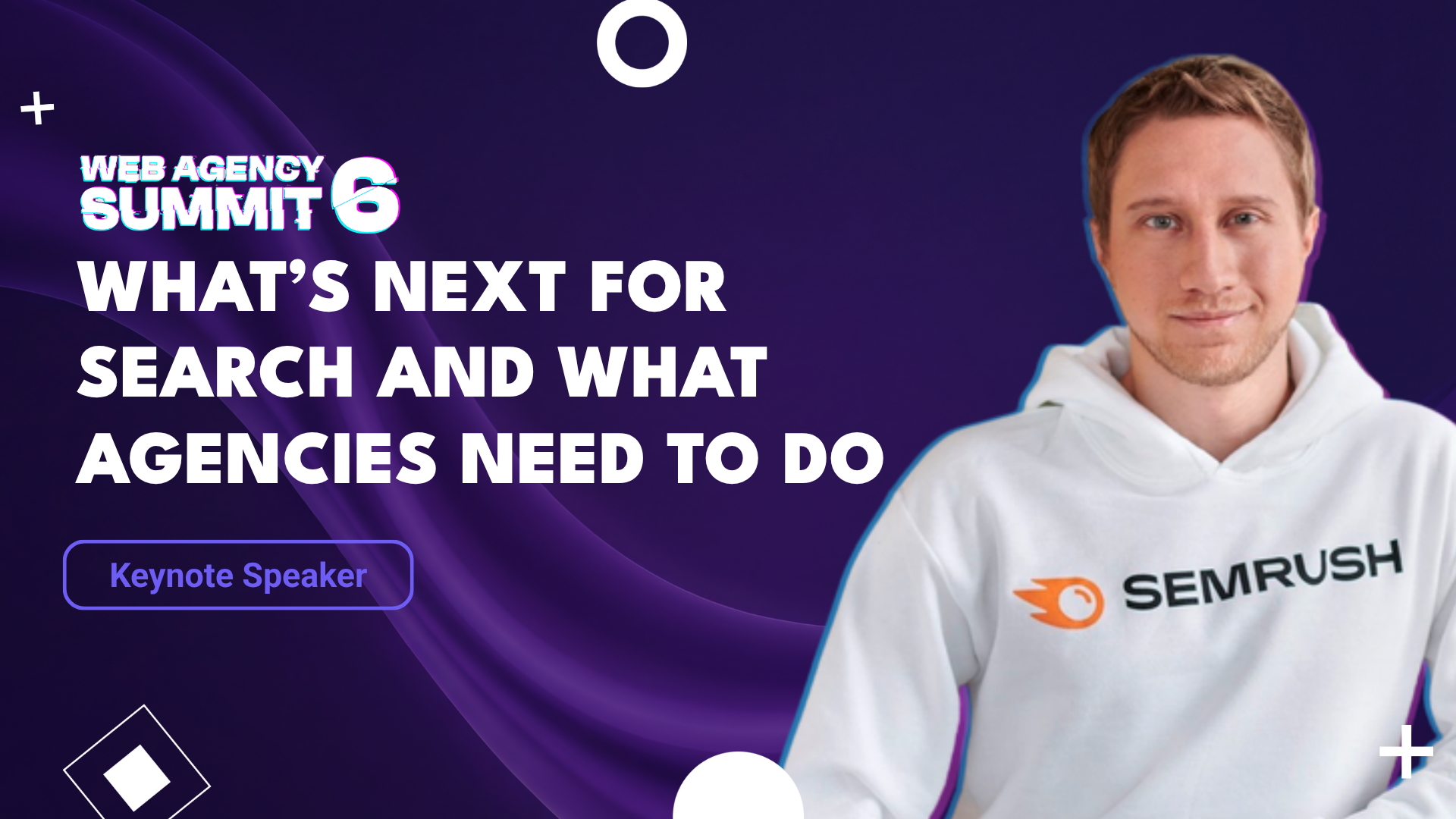
Eugene Levin, President of Semrush, joined Web Agency Summit 6 for a wide-ranging conversation covering the transformation of search, the rise of agentic search (also called AI visibility or GEO), and what digital agencies must do to survive and thrive.
Drawing on his experience leading Semrush through a $750 million IPO and into a $1.9 billion acquisition by Adobe, and his background as a venture capital investor, Levin argued that the shift from traditional SEO to AI-powered search is not a reason for panic but a call to action.
His core message was blunt: agencies that embrace the new landscape, automate content production, specialise in a niche, and build sales operations that do not depend on the founder will pull ahead. Those that cling to the old model, or that deliver outstanding technical results but fail to manage client expectations and retain business, will struggle regardless of skill level.
He also introduced a significant reframe for how agencies should position agentic search services to clients: less as performance marketing with hard ROI metrics, and more as brand marketing with existential urgency. AI visibility is now a boardroom concern. CEOs are being asked by their boards why AI does not recommend their company. That creates a new kind of commercial leverage for agencies who position themselves correctly.
Key takeaways
- 01The job of SEO has expanded to include qualitative AI monitoring. It is no longer enough to track whether you rank; agencies must now track what AI says about their clients and whether those mentions are accurate and favourable.
- 02Agentic search optimisation (also called GEO) is a new service category that requires a market education approach, not just demand capture. Agencies that invest in educating the market now will be positioned as leaders when AI search becomes the norm.
- 03The shift from clicks to citations means attribution is broken. Agentic search is closer to brand marketing than performance marketing, and agencies should frame it that way to clients and CFOs.
- 04Agencies that thrive are not necessarily the best technical marketers. They are the ones that build scalable sales teams and manage client expectations through the full lifecycle, including the inevitable plateau phase.
- 05Niching down into a specific vertical or service area is one of the highest-leverage moves an agency can make. Vertical expertise commands premium pricing and reduces client churn.
- 06Brand visibility across the full web ecosystem, including third-party sites, reviews, Reddit, YouTube, and LinkedIn, now directly influences AI recommendation outcomes. Reputation management and SEO have merged into one discipline.
- 07Publishers face genuine uncertainty about monetising in an AI-driven world. The affiliate and mention economy may shift in their favour, but only if they adapt. Agencies that act as intermediaries between publishers and brands will find the middleman role remains valuable.
- 08Website architecture now needs to serve two distinct audiences simultaneously: human users and AI agents. Technical SEO audits must account for how AI crawlers navigate and interpret site structure.
- 09The single biggest dividing line between successful agencies and struggling ones is not marketing skill. It is the ability to sell without the founder and to retain clients through honest expectation management.
Lessons from Scaling Semrush: What He Would Do Differently
Levin was asked to reflect on one decision he would make differently if he could go back.
He noted that Semrush was founded as a bootstrap company, and when he joined, the founders had built a strong culture of financial prudence over eight years. The company raised capital after he joined but never spent it, because the instinct to run lean was deeply embedded in the culture.
In retrospect, he believes they could have grown more aggressively in those earlier years.
The conservative spending culture, while admirable in many ways, may have limited the speed of growth at a stage when more aggressive investment would have compounded favourably.
His second reflection was about the timing of the IPO in 2021. He believes going public at that moment was the right call given what they knew at the time, but in hindsight, they would have been better served by beginning the shift from a growth-first orientation to a profitability-first orientation earlier. In 2021, the market was still rewarding growth at all costs, but that shifted rapidly. It takes a trader one second to reprice a company based on new preferences. It takes a management team two to three years to genuinely transform a business from growth mode to profitability mode, and not every company survives that transformation.
He added that Semrush navigated this better than most peers in its IPO cohort, because the bootstrap culture gave them the underlying muscle memory to run profitably when required.
But he would have started that transition earlier.
What Levin Looks for in Founders as an Angel Investor
Levin was a VC partner for most of his early career before transitioning to angel investing alongside his operating role at Semrush. He described the differences between the two frameworks.
As a VC, the game is about not missing any of the twenty to forty companies in any given year that will become genuinely large. Portfolio math is driven by outlier outcomes. Even if most deals underperform, the winners define the fund. That creates a specific mindset: cast a wide net and optimise for not missing the breakout company.
As an angel investor, his framework is entirely different. He is looking for businesses where he can add real value, generate returns above what public markets would deliver, and back founders running sustainable, well-run businesses. A hundred-million-dollar valuation outcome for a company he backed early works perfectly well within his goals.
On the traits that separate founders who can grow to the next level: Learning and openness. The ability to genuinely absorb lessons from other people and from your own mistakes is rarer than it sounds. Most people are stubborn in a counterproductive way. They know what they know, and they resist revising it.
Curiosity. Levin described this as an almost uncontrollable desire to understand what customers need, how the world works, what products would drive more revenue, and how to do monetisation and go-to-market differently. At early stages, you are building products that do not yet exist, so you cannot rely on prior playbooks. You have to be genuinely curious enough to pull the best thinking from your network and from what you observe in other companies, and then synthesise it for your own context.
Calibrated stubbornness. The same founder who needs to be open to learning also needs to be stubborn enough to push back when advice they are receiving is not applicable to their specific business. Levin acknowledged that he cannot know every nuance of the businesses he advises. Some of his experience will be directly applicable; some of it will be noise. He needs founders who can tell the difference.
He emphasised that he is not looking primarily at financial discipline or operational hygiene as differentiators. Those are prerequisites for being at the table. What gets a business from where it is to the next level is curiosity, learning, and the confidence to act on what you have learned while filtering what does not apply.
The Adobe Acquisition: Strategic Fit and the Logic Behind It
Levin addressed the acquisition of Semrush by Adobe, noting that details are publicly available through regulatory disclosures. He framed the deal in terms of strategic fit rather than financial engineering.
He pointed to the Adobe Summit presentation by Anil, President of the Adobe division handling the acquisition, as a clear articulation of the rationale. Semrush serves as a data layer, providing insight and intelligence that powers implementation. The broader thesis is that in an AI-first world, brand visibility across the internet is a prerequisite for commercial success. AI agents pick up signals from third-party websites, brand-owned properties, social
media platforms including Reddit, YouTube, and LinkedIn, and many other sources. A brand's visibility across all of those places directly influences whether AI recommends it.
Semrush has built tools and frameworks for what some call GEO, and what Semrush calls agentic search optimisation, though Levin acknowledged the taxonomy is still settling.
Adobe already has a leading implementation platform. Combining Semrush's data and insight layer with Adobe's implementation capabilities creates a more complete solution for customers than either company could offer independently.
Levin offered this as the template for thinking about any acquisition of this type: there needs to be a stakeholder on the buying side who genuinely sees how two products combine to create something more valuable for the end customer. One-plus-one-equals-five logic, not just customer acquisition for its own sake.
The State of Search in 2026: What Has Changed and What Has Not
What Agencies Should Stop (or Rather, Transform) Asked what a 15-person agency doing $1 to $2 million in revenue and focused on traditional SEO should stop doing, Levin was deliberately measured. He argued the answer is not to stop doing things but to do them more efficiently.
Content production is the clearest example. Agencies that are not running largely automated content production pipelines by now are not price-competitive. The raw volume of content creation should be handled by AI. The human role shifts to configuring workflows, reviewing outputs against brand guidelines, and ensuring factual accuracy. In net terms, the amount of content being produced for clients should increase significantly, perhaps fivefold, while the cost of production falls.
What does change is the type of content being produced. In the past, the focus was long-form search content optimised for traditional rankings. Now, agencies must also think about the questions people ask directly in large language models like ChatGPT, the questions answered by Google's AI Overviews, and questions that do not look like traditional search queries at all. Each of those surfaces may require different content structures, formats, and framing.
The Qualitative Dimension: From Binary Ranking to Monitored Mentions Levin introduced what he called a genuinely new dimension to the work that did not exist in traditional SEO. In the past, visibility was binary: either you ranked or you did not. The outcome was a click or no click.
In the agentic search environment, there is now a qualitative layer. A brand might be mentioned in an AI response, but the mention could contain incorrect information. Levin gave the example of an airline: a user might ask which airlines offer refundable tickets, the AI might mention the brand but state incorrectly that they do not offer refundable tickets,
when in fact they do but the information is unclear on the website. The brand is present in the AI response, but the mention works against it.
Agencies must therefore monitor not just whether clients appear in AI outputs but what those outputs say, whether it is accurate, whether it is up to date, and whether the framing is favourable or unfavourable. This is a new service capability that requires new tooling and new analytical frameworks.
The Convergence of SEO, PR, Reputation Management, and Social Levin made a strong structural argument here: the disciplines that used to be managed separately, SEO, PR, community management, review management, social media, are now operationally unified by the fact that AI pulls signals from all of them simultaneously.
If a brand has poor reviews, it will not achieve strong AI visibility regardless of how well its website is optimised. If a brand's social media presence is weak or inconsistent, that matters to AI recommendation engines. What used to be categorised as separate service lines is now one interconnected job.
This does not make agencies' lives easier. It makes them deeper and broader simultaneously.
But Levin's point was that the core skills have not disappeared. The need to create content persists. The need for outreach persists, except now outreach aims to secure mentions and influence what third-party sources say about a brand, rather than purely to acquire links.
The underlying craft remains; the tactics and scope have expanded.
Outreach in the Agentic Era: From Links to Mentions
Levin drew a direct parallel between traditional link-building outreach and what agencies now need to do in the agentic search world. The mechanics are similar: identify relevant third-party publishers and websites, build relationships, and negotiate placement of your client's information in their content.
The difference is that the currency has shifted from links to mentions. And in some respects, he argued, the new version is actually easier to execute than link building was. Publishers were always nervous about selling links because of the risk of Google penalties and the potential for detection. With mentions, there is no equivalent traceable signal. A piece of text mentioning a brand in context cannot be easily identified as a paid placement the way a link can be audited.
For agencies with existing link-building relationships, this is a genuine competitive advantage. The relationship infrastructure, the knowledge of which publishers accept placements, the rate cards, the editorial contacts, all of that transfers directly to mention-based outreach. Agencies that have this foundation are well-positioned to offer mention management as a natural evolution of what they already do.
AI Visibility as Brand Marketing, Not Performance Marketing
The Attribution Problem Levin identified the lack of attribution as the defining challenge for agentic search optimisation from a commercial and financial management perspective.
Traditional SEO worked as a performance marketing discipline because the causal chain was traceable: content was created, the page ranked, a user clicked, and if a transaction occurred, you could connect the investment back to the outcome. This made ROI calculations possible and gave CFOs a framework for justifying spend.
Agentic search breaks this chain. A user might see a recommendation in an AI response and not act on it immediately. For high-consideration purchases, the gap between initial AI exposure and eventual transaction could be six months to a year. The agency's work influenced the outcome, but the connection cannot be directly attributed.
Semrush has built products designed to restore some of this visibility, but even the best tooling available makes agentic search attribution more probabilistic than certain. Especially for smaller companies without extensive data infrastructure, the measurement problem is real.
Reframing as Brand Marketing Levin's prescription was to stop fighting this reframe and lean into it. Agentic search optimisation should be positioned to clients as brand marketing, not performance marketing.
This is actually a commercially advantageous framing, he argued. Brand marketing has always operated with less precise ROI measurement, and yet the world's largest companies spend enormous sums on it. Coca-Cola and consumer goods companies invest orders of magnitude more in brand than they do in organic search, and they do not expect a direct transaction-by-transaction return. The model of investing in brand to maintain market presence and consumer consideration is well understood at the board level.
By positioning AI visibility as a brand marketing question, agencies can tap into a larger budget pool and avoid the trap of trying to defend specific traffic and conversion numbers in an environment where the measurement infrastructure does not yet fully support that.
The Boardroom Urgency Angle Beyond the budget framing, Levin pointed to a new dynamic that agencies can use to create urgency in client conversations. AI visibility has become a boardroom issue. CEOs are being challenged by their boards to explain why AI does not recommend their company for relevant queries. That kind of executive pressure is not something that can be given a precise price tag, but it creates the conditions for a fundamentally different commercial conversation.
Agencies can shift from "here is the ROI on this specific campaign" to "this is existential. If AI does not surface your brand, you are invisible to a growing segment of buyers." That framing closes budget conversations very differently.
Market Education as a Strategy for New Service Categories
Levin discussed the role of editorial content, industry media, and thought leadership as tools for market education, using Semrush's acquisition of Search Engine Land as context.
He drew a distinction between two types of marketing challenges. The first is where a service is genuinely new and the market does not yet have an established need or vocabulary for it. In that situation, the job of marketing is not to capture demand but to create it. You have to explain the value, convince prospective clients to invest in something before the payoff is fully visible, and establish the category itself.
This is the position that agentic search optimisation occupied eighteen months ago. When Semrush started building products in this area, AI Mode did not exist. AI Overviews were limited to informational queries. ChatGPT was still growing and had not yet become a significant part of the consumer journey. Semrush built the products anyway, started educating the market, and told agencies: a year from now, you will not be able to sell SEO alone. You will need agentic search optimisation in your offering. If you do not learn the service now, you will be behind.
That long-term market education investment, through industry media, PR, events, partnerships, and editorial content, is what creates leadership in new categories. It is not immediately profitable. But if you want to own a space, you have to do it.
The second marketing challenge is managing established demand. Once a category exists and buyers know what they want, the job shifts to being discoverable within that demand pool, targeting the right people through the right channels, and differentiating on value rather than category definition.
Levin noted that Atarim, the host company, faces a similar market education challenge. Its product is genuinely innovative and does not have a clear competitor so much as it competes with people doing things the old way. Education is a core part of that commercial strategy.
You have to explain the value, convince prospective clients to invest in something before the payoff is fully visible, and establish the category itself.
How Agencies Should Define Their Service Boundaries
Levin was asked directly how an agency should decide when to say no to expanding its service offering, given the pressure to master SEO, content, paid media, social, AI, GEO, and more simultaneously with the same team.
His framework was practical. He argued that agencies need to think about the buyer persona they are actually serving, not the company name on the contract. An agency might work with Bank of America, but the real client is a specific person within a specific budget at Bank of America. That person buys a specific set of services. The fact that Bank of America also runs brand advertising somewhere else in the organisation is irrelevant to this relationship.
His recommendation was to identify that buyer persona clearly, then talk to ten people who hold that role in the type of companies you want to serve. Ask what they typically buy from agencies. Map the overlap across those conversations. For any service that appears in the majority of those conversations, you want to offer it. For a service that only one or two people mention, it is probably too niche to build a practice around.
Within that service map, the goal is not to be the best at everything. It is to be definitively the best at one thing, the thing that lands the initial engagement. For everything else in the portfolio, you want to be as good as the next credible alternative. That is the threshold: good enough that the client does not need to go elsewhere, even if they could find a marginally better specialist for that specific sub-service.
He also raised the discoverability problem, which he had seen play out at Semrush itself. At a certain point, the company had built so many features that users simply did not know they existed. Being broad is not enough if clients do not know you offer the thing they need.
Agencies that expand their service lines without building structured ways to surface those capabilities to existing clients will lose revenue to competitors even while the capability sits unused.
What Separates Thriving Agencies from Struggling Ones in 2026
Being Good at Marketing Is Not Sufficient Levin offered a deliberately uncomfortable observation here. From the data available to Semrush, which sees performance results from agencies tracking visibility for their clients, the correlation between marketing quality and agency business health is weaker than most people would expect.
He described cases where an agency had done a genuinely outstanding job, delivering measurable results for a client, and still lost the relationship. And cases where performance was mediocre but the client stayed. The work matters, but it is not the primary driver of agency success.
Building Sales That Do Not Depend on the Founder The most important structural factor Levin cited was the ability to build a sales function that operates independently of the agency founder. Most agency owners are the primary or sole salesperson. That creates a direct ceiling on growth. As client count increases, more of the founder's time goes to selling, less goes to delivery, delivery suffers, and the agency stalls. For a very efficient solo operator, this ceiling might sit at a comfortable $1 to $2 million in revenue with strong margins. But for an agency operating with average or below-average efficiency, the ceiling is lower and the margins thinner. A single large client departure can put the business into the red. There is no buffer.
Agencies that break through this ceiling are the ones that invest early in sales infrastructure that does not require the founder's presence to function. That frees the founder to function as subject matter expert and delivery leader, which is where most of them add the most value.
Managing Expectations Through the Success Plateau The second structural issue Levin described was what he called being a victim of your own success.
Agencies often win clients and deliver dramatic early results, particularly when there is significant low-hanging fruit: technical fixes, content gaps, or visibility issues that produce rapid improvements in the first few months. That early momentum builds strong client relationships and generates enthusiasm.
The problem arrives later. Growth rates plateau, not because the work has degraded in quality, but because the client has reached a natural ceiling in their market niche. At full saturation of their target audience, flat performance is actually the appropriate result of good maintenance. But clients who experienced significant early wins have recalibrated their expectations upward. When results flatten, they assume the agency has stopped working hard or has run out of ideas.
What typically happens is predictable: the client starts looking for greener grass, switches agencies, slowly sees their metrics deteriorate without the agency's active work, realises what they had, and eventually returns. But an agency that did not have a durable sales pipeline might not survive the gap between that client's departure and their return.
The skill of managing this dynamic, setting realistic expectations before they are violated, communicating proactively when natural ceilings are being approached, and reframing maintenance as a legitimate ongoing service, is one of the most underrated capabilities in agency management. Levin was explicit that this is what separates agencies that compound over time from those that churn through clients.
Brand Marketing in B2B: Is It Worth It for Smaller Players?
A question came in from the audience about whether smaller B2B tech companies are increasing investment in brand marketing.
Levin confirmed he is seeing this trend. But he qualified it carefully. Brand marketing makes sense when a company has genuine differentiation. If you have a unique value proposition, a distinctive product, a specific niche, or something that makes you meaningfully different from alternatives, brand investment amplifies that. It increases surface area across the channels that feed AI recommendation engines, and it builds the kind of ambient reputation that influences consideration even when a buyer is not actively researching you.
He contrasted two types of brand that work. The first is the differentiation-based brand: smaller, distinctive, premium, the Patagonia model. Patagonia dominates AI search results and agentic recommendations not because it is the biggest apparel brand but because it has a clear and consistent message around sustainability, materials, and environmental values.
Brand marketing has made that message pervasive enough that AI systems register it as authoritative.
The second is the safety-based brand: Salesforce, McDonald's, Coca-Cola. Buyers choose these not because they are the best option but because they carry no risk. Nobody gets fired for choosing Salesforce. Nobody gets food poisoning at McDonald's. These brands exist to reduce perceived risk, not to win on merit. Small agencies cannot build this type of brand equity, but they can understand why it works and avoid competing against it directly.
For small agencies and B2B companies, the actionable insight is to invest in brand only when you have something specific and defensible to say. Generic brand spend without a clear point of differentiation is wasted money.
For small agencies and B2B companies, the actionable insight is to invest in brand only when you have something specific and defensible to say.
AI-Built Websites and Technical SEO for an AI-First World
Levin was asked two related questions: whether websites built by AI tools have adequate SEO quality, and whether websites need to be fundamentally re-architected for the current environment.
On re-architecture, his answer was unambiguous: yes. When conducting a technical SEO audit today, agencies must consider that they are building for a new type of visitor. AI agents browse websites differently from human users. They navigate structure differently. They interpret content differently. Websites that are not legible and navigable to AI crawlers will underperform regardless of how well they are optimised for human readers. This represents a genuinely new dimension of technical SEO.
One attendee noted that roughly 50% of website traffic is now generated by bots of various kinds, including AI crawlers. Building for two distinct audiences simultaneously creates additional complexity but also additional opportunity for agencies that understand both.
On AI-built websites, Levin was pragmatic. He drew a historical parallel with Wix. When Wix first emerged, its reputation among SEOs was poor, largely because of technical limitations including the use of Flash-based elements that were essentially invisible to search crawlers.
Over time, Wix upgraded its platform and the reputation problem dissipated. Today, Wix websites can rank competitively. The platform is not the primary determinant of rank.
Similarly, AI website builders today may not produce the most technically refined output, but the gap between them and custom-built alternatives is narrowing. Platforms like Shopify have invested heavily in performance and have very competitive loading speeds. For non-specialists, using a modern AI or hosted website builder is a reasonable choice. The factors that determine AI visibility and traditional search ranking today are increasingly about authoritativeness, content quality, and crawlability rather than which specific platform or hosting environment the site runs on.
Optimism and the Broader Outlook
Levin closed the session with a strong note of optimism, which he acknowledged runs somewhat against a prevailing current of anxiety in the industry.
He argued that the level of innovation currently unfolding, and the productivity gains it enables, will be genuinely remarkable. The businesses and individuals who position themselves to learn continuously and embrace new tools will see possibilities that are not yet visible.
He cited Semrush's own growth as a concrete example. The company experienced significant revenue growth in the prior year from products that did not exist in 2024 and were launched in early 2025. The upside of operating at the frontier of a rapidly changing industry is real.
His message to agencies and founders: do not try to wait out the change. There is no safe corner to hide in while the transformation passes. The companies that embrace change, learn continuously, and use the best available tools will be the ones with the brightest futures. Those who try to preserve the status quo will find it cannot be preserved.
 About the speaker
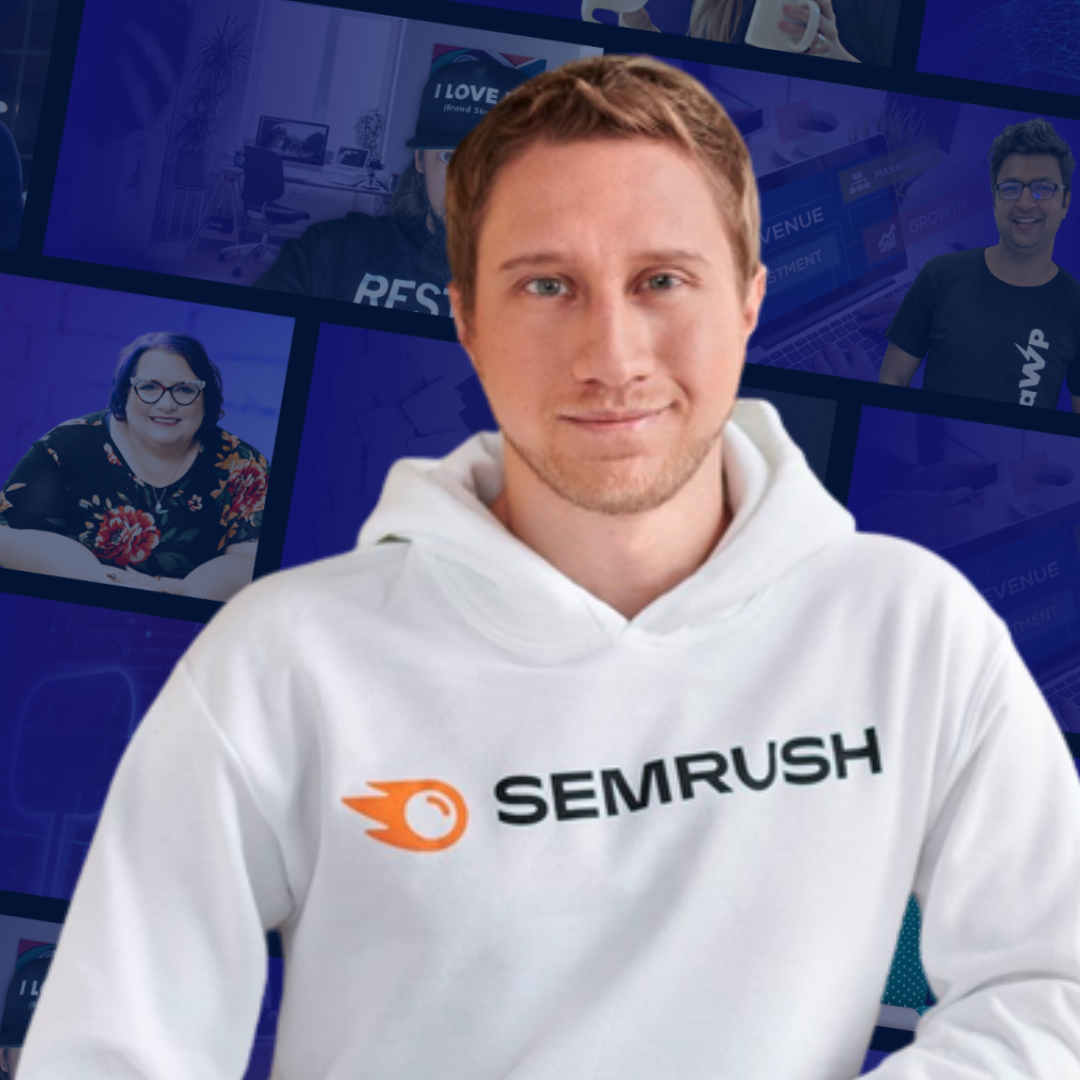
Eugene Levin
President of Semrush
About the speaker
Eugene Levin
President of Semrush
Eugene Levin is President of Semrush, where he has spent years helping the company scale into one of the most widely used SEO and marketing platforms in the industry. He works closely with agencies and marketers navigating the shift from traditional search to AI-driven discovery.