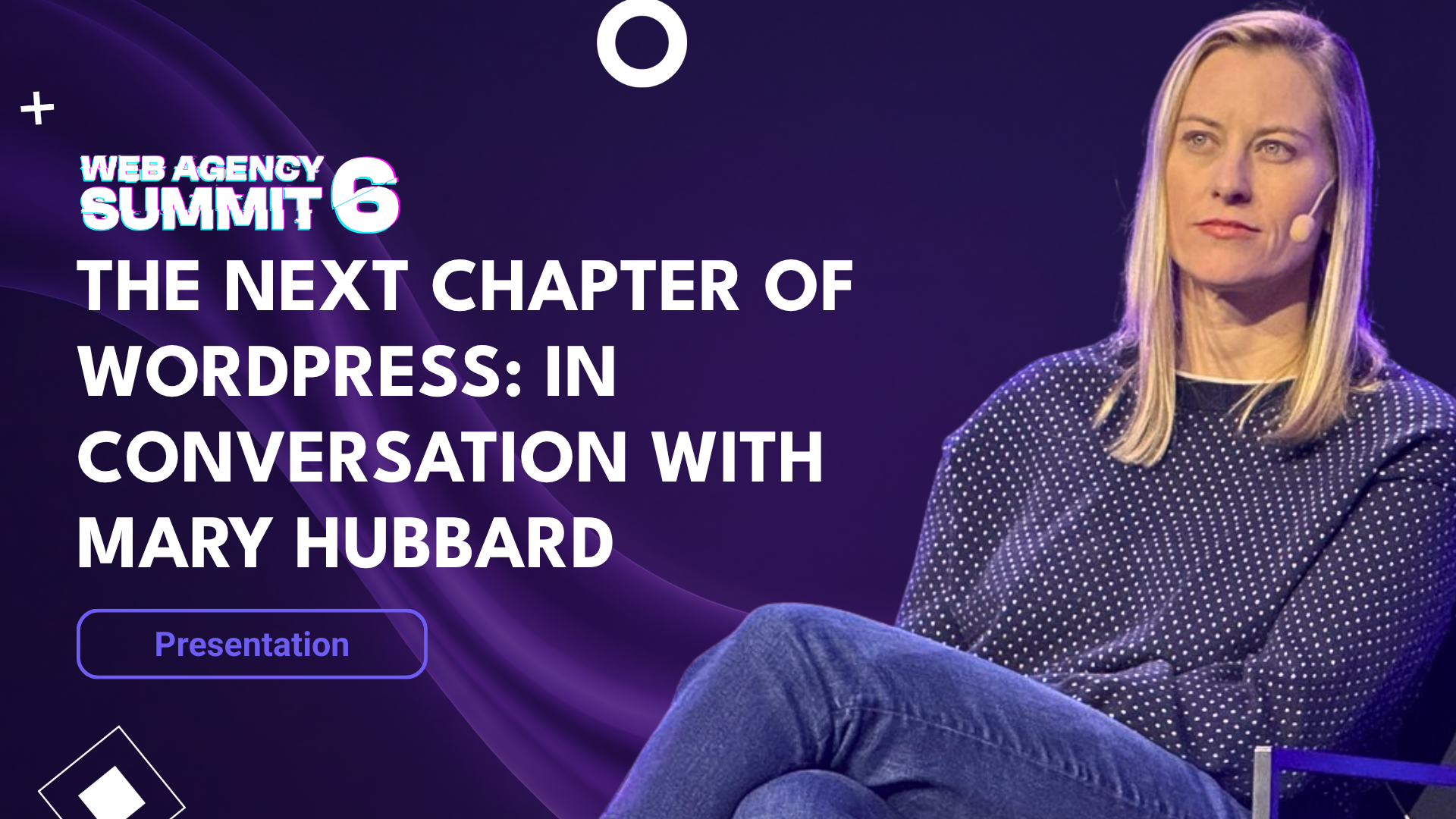
Mary Hubbard, Executive Director of WordPress.org, joined the Atarim Web Agency Summit for a wide-ranging fireside chat. With approximately 18 months in the role at the time of recording, she spoke candidly about her approach to leadership within the WordPress project, how her commercial background at eBay and TikTok is shaping the project's direction, the reasoning behind the WordPress 7.0 delay, and her vision for WordPress in the age of AI.
Key themes across the conversation included: WordPress as a foundation for the open web in an AI-driven future; the importance of transparency and community-led decision- making; the distinction between WordPress.org marketing and individual ecosystem storytelling; the danger of locking WordPress into a single AI implementation; and the pressing need to bring younger generations into the WordPress community through education, credentials, and a jobs pipeline.
Mary is candid about her own discomfort with public speaking and her preference for behind-the-scenes connection work. She frames her role less as a director and more as a connector and unblocking agent, listening deeply, bringing people together, and nudging the project forward without dictating it. The session ends with a rapid-fire discussion of upcoming WordCamp appearances and a call for the community to embrace education as the most durable form of WordPress marketing.
Key takeaways
- 01The delay to WordPress 7.0 was handled publicly and deliberately. She credits the delay with surfacing gaps in contributor coordination and setting a new standard of transparency for how major releases are built.
- 02Her experience at eBay and TikTok is actively shaping how she pushes for speed, outcome-focus, and customer proximity inside the WordPress project, which traditionally operates much more slowly and by consensus.
- 03She has a direct, sometimes difficult working relationship with Matt Mullenweg, but frames it positively: she pushes back frequently, he frequently says no, and she finds that her persistence often shifts thinking over time.
- 04WordPress is intentionally not building a native, opinionated AI builder into core. The priority is to establish the foundation layer first: connectors, permissions, and open standards. Plugins are the right place for AI innovation.
- 05She believes WordPress is uniquely positioned to lead on AI and the open web, and that the project's scale means it can actively shape how society relates to individual domain ownership, human-generated content, and AI literacy.
- 06On marketing: WordPress is a "leaky bucket" for traditional campaigns because every host or agency that markets it is primarily marketing themselves. A consistent narrative around specific programs and WordPress values is more effective than a centralised marketing push.
- 07Agencies need to stop selling builds and start selling ongoing, productised value. The web is going to get more complex, not simpler, and the fear that creates is an opportunity for agencies who can communicate clearly and guide clients through it.
- 08She wants 2026 to be "the year of the meetup" and is personally committing to attend and participate in meetups, not just major WordCamps, as part of her push to re-energise grassroots community.
- 09The WordPress ecosystem has approximately 700,000 open job listings globally. She sees formal, globally-recognised credentials tied to WordPress skills as a way to close that gap, bring in younger contributors, and elevate current contributors to new opportunities.
Mary's Philosophy of Leadership: The Connector, Not the Director
One of the defining themes of the conversation is how Mary conceives of her role. She explicitly rejects the idea that her job is to tell people what to do. In open source, she observes, you cannot simply direct — you have to bring people along. Her preferred metaphor is one of "shining light": rather than fighting with detractors or trying to eliminate negativity, the more effective move is to focus attention and recognition on those who are contributing well, persevering, and trying.
She acknowledges that when she first joined she asked for grace from the community as she learned and found her footing. She understands emotionally and logically why some people in the WordPress community have strong, even hostile, reactions. But she is clear that negative voices are a permanent feature of any project at this scale and that the answer is not to engage in combat but to keep showing up, being kind, and pushing things forward.
Her actual work, she explains, is largely invisible: conversations behind the scenes, connecting contributors who need to talk, unblocking people who are stuck, and reducing friction wherever she can. Most of what she does does not happen in front of a crowd or in a public channel. She describes the project as fundamentally being about people, and says the things she has prioritised in 2026 are not things she invented — they came from community feedback that had been accumulating for years.
She would like to see more visible, accountable leadership emerge within the project. She names Jonathan DeRossi, Peter Wilson, and Jordan as examples of people who are coming in and giving direction, and says she wants to see more of this pattern: leads and dev leads who can make decisions quickly without fear.
Commercial Background and Its Influence on WordPress
The host draws a direct line between Mary's time at eBay and TikTok and the way she is approaching her role at WordPress.org. She agrees the influence is real, though she frames it carefully.
At eBay she worked on the launch of Part Center, an early PIM (product information management) system for the eBay Motors vertical. The work was commercially focused and fast-moving. She has a model-scale die-cast eBay Motors race car somewhere in a box from the team's sponsorship of a racing team at the time — a detail she mentions with affection.
At TikTok she observed a mode of working that is centralized, outcome-driven, and fast.
Decisions come from the top and are executed quickly. Multiple teams work on the same problem simultaneously, trialling different solutions until the best one emerges. She acknowledges this is very different from how open source works, but believes WordPress can learn from TikTok's focus on getting close to the customer quickly and optimising for outcomes rather than process.
She sees a narrative shift already happening inside the WordPress project, moving toward quicker iteration, more public work, and faster feedback loops. The delay and eventual resolution of the WordPress 7.0 situation is, in her view, a positive example of this shift in action. It was messy, but it was transparent, and it moved things in the right direction.
WordPress 7.0: The Delay, the Collaboration Feature, and What It Revealed
The host raises WordPress 7.0, noting it was scheduled for around the 20th of May (which he observes is his birthday week) and that it was delayed because of issues with the Collaboration feature. He asks how much influence Mary has over release decisions and what the situation revealed.
Mary explains that she is actually on the release squad for 7.0, so she has meaningful involvement in the process. Concerns about the release were brought directly to her and to Matt Mullenweg by contributors who were unhappy or disagreed with the implementation approach. Her response, consistent with her connector philosophy, was to bring the relevant people together, surface the conversations, and create the conditions for swift decisions.
She is careful to credit the core committers who actually build the features — her role is not to override technical judgment but to ensure the right conversations are happening. In this case, she says, the implementation needed more time and more thinking. The decision to
delay was made collaboratively, with community members pulled in to help set new dates and structure the testing and feedback process.
She views the outcome positively. The delay did not just fix a problem — it showed where the gaps were in how contributors on a major release communicate and collaborate with one another. It also created a visible example of a new way of doing things: more transparent, more public, faster in getting to a decision even if the timeline itself extended. She says she likes how the situation played out and thinks it sets a useful precedent for 7.1 and 7.2.
Relationship with Matt Mullenweg and Autonomy Within the Role
The host raises the question of autonomy and asks directly how Mary navigates working with Matt Mullenweg, who is both CEO of Automattic and co-founder of WordPress, and who functions as a BDFL (Benevolent Dictator for Life) over the project.
Mary gives a candid and thoughtful answer. She says her role extends well beyond core product features — she is deeply autonomous in areas like educational programs, AI initiatives, foundation activity, and community health. She drives and runs those areas without being told what to do.
But she is equally candid that Matt says no to her frequently. She says she is "never really told yes" and that she gets "slotted down and told no all the time." She does not experience this negatively. She frames it as consistent with how she worked at TikTok and eBay: you have an idea, you drive it, and sometimes it does not fly. You take the context from the no and keep pushing in slightly different directions.
What she finds effective is that when she brings evidence, perspective, or a different framing to a conversation with Matt, he reflects on it. She says he is a strong, intelligent founder-CEO with strong opinions, but those opinions are "held loosely" in the sense that they are genuinely open to revision when presented with good reasoning. She pushes back, asks for clarity, and navigates his feedback with the knowledge that the North Star — where the project is trying to go — can be reached through different execution paths.
She wants to see more of this kind of leadership culture across the project: people who are not afraid to make low-level decisions, who understand that moving fast means some things will not work, and who are empowered to proceed and course-correct rather than waiting for consensus on everything.
You take the context from the no and keep pushing in slightly different directions.
WordPress and AI: Foundation First, Not Opinionated Builder
One of the most substantive product discussions in the session concerns artificial intelligence and whether WordPress is deliberately avoiding building a native AI page builder into core to protect the plugin ecosystem.
Mary is direct: it is not about protecting plugins from competition. The reasoning is architectural and philosophical. Building one opinionated native AI builder into WordPress core would risk locking the entire ecosystem into a specific workflow, a single provider, or a single model. Given that no one knows exactly where AI technology or society's relationship with AI is headed, that would be a mistake.
The correct move, she argues, is to build the foundation layer first: the connectors, the permissions architecture, the open standards that allow any AI tool or provider to interact with WordPress cleanly and consistently. Those standards need to be continuously reviewed and updated as a project-wide concern. Once the foundation is solid, plugins are the right place to innovate and compete.
She encourages anyone interested to go and read the public discussions in Make WordPress about these decisions, noting that the debates were substantive and the arguments were well-made on both sides. She frames the plugin ecosystem's role here as a strength: the gaps plugins have always filled are what enable ecosystem development and commercial success.
That will remain true in the AI era.
She also notes the risks of over-investing in a solution that might become irrelevant. A plugin that solves a genuine problem today might find that the problem has been redefined or displaced by AI in two years. The foundation layer approach keeps WordPress adaptable to whatever comes.
Marketing WordPress: The Leaky Bucket Problem
The host raises the question of WordPress marketing with some passion, noting that WordPress.org has not mounted a serious marketing effort and that the platform suffers from persistent negative perception even though it powers over 40% of the web and is, in his view, the best CMS available.
Mary's response is nuanced and introduces her "leaky bucket" framing. When anyone — a host, an agency, or a marketing team — spends money promoting WordPress, they are not really promoting WordPress the project. Hosts are promoting their own hosting. Agencies are promoting their own services. The value of the campaign disperses across the entire ecosystem, which makes it almost impossible to track impact or justify the spend from a WordPress.org perspective.
She is not opposed to a marketing team for WordPress — she says explicitly that if someone is willing to show up and drive it, she would not block it. But she thinks that a centralised campaign around features or product comparisons is less effective than consistent,
continuous storytelling tied to specific programs and values: freedom, ownership, flexibility, open source.
What she does believe in is individual and program-level promotion. Every time she speaks publicly about the AI micro-credential or educational programs, she gets significant inbound interest. She sees this as proof that targeted, story-driven promotion works better than a flashy campaign. She wants to see more WordPress ecosystem participants — individuals, agencies, community leads — out telling their own WordPress stories, because collectively those individual narratives are more credible and more diverse than anything a centralised campaign could produce.
She also floats the idea of riding the wave of AI interest to market open source principles more broadly: the individual domain, the personal website, human-generated content. She thinks these ideas have strong natural tailwinds in a world where AI-generated content is becoming the norm, and WordPress is uniquely positioned to represent the alternative.
What Agencies Should Be Preparing For
One of the most practically useful sections of the conversation is Mary's answer to a community question from someone identified as Uta, described as a successful solo WordPress developer in Germany. The question is: what should agencies be preparing for now that they are probably underestimating?
Mary's core argument is that agencies need to stop selling builds and start selling ongoing, productised value. The ability to spin up a website quickly is becoming commoditised. More automation means more fragmentation, which means more pricing pressure on the commoditised end of the market. Agencies that compete purely on build speed or price will face increasing pressure.
The opportunity, she argues, is in complexity management. The web is not going to get simpler — it is going to get more complex. AI is accelerating that complexity, and many clients are experiencing real fear about what the future of the web means for them.
Agencies that can name that fear, explain what is happening, and guide clients confidently through the complexity have an increasingly valuable role to play.
She also identifies a broader opportunity for the WordPress ecosystem to "take a seat at the table" and actively shape public understanding of what the web should be. The individual domain, the personal voice, the piece of the web that belongs to a specific person or business — these are going to matter more, not less, as AI-generated content proliferates.
Agencies can be the people who make that case to their clients and help them act on it.
Her practical advice: productise the parts of your offering so you are not reinventing the wheel on every project; focus on the value you provide rather than the deliverable; and build a clear narrative about why your agency is the right partner for navigating an increasingly complex digital landscape.
On Forking WordPress and Distributions
A question from community member Robert Jacoby asks whether it makes sense for agencies to fork WordPress — to create their own distributions analogous to what has happened in the Linux ecosystem — in order to serve niche or emerging markets.
Mary's answer is measured. She does not dismiss the idea entirely but says forking should be the last move, not the first. Creating a fork puts the maintenance burden for security, updates, and core infrastructure directly on the agency, which is a significant responsibility that the open source project currently absorbs on behalf of everyone.
She says forking might make sense if a business genuinely needs it — for example, if the use case demands very opinionated defaults, specific compliance features, or a vertically focused platform that cannot be achieved through configuration and plugins. She mentions "WP Pharma Distro" as a hypothetical example raised in the background chat.
But for most agencies, she recommends staying within the ecosystem and productising from there: curated plugin stacks, custom workflows, defined onboarding, opinionated configurations. She acknowledges that large enterprise agencies like Human Made and Ten Up already effectively have their own highly opinionated WordPress installs — but those are working within the ecosystem rather than forking away from it. Forking is a product decision for a very specific commercial context, not a general strategy.
Visibility, Community Presence, and the Year of the Meetup
The host asks about Mary's growing community visibility. She is candid that she does not enjoy public speaking, is uncomfortable on stage, and would rather be in the audience or in one-on-one conversation. She got significant criticism early in her tenure for coming into the WordPress community without being perceived as part of it, and she responded by deliberately spending time inside the community: joining the 7.0 release squad, running her first release candidate process, and engaging directly with the people building things.
She is clear that she is not going to become a frequent keynote speaker, partly by temperament and partly because she does not think that is where her value lies. She mentions Matt Mullenweg as someone who already fulfils that role at every major WordCamp. Her preference is to be useful in different ways.
What she is committing to is the meetup circuit. She has said publicly that she wants 2026 to be the year of the meetup — a re-energising of the local, grassroots community infrastructure — and she feels she needs to show up and participate herself if she is going to ask others to do the same. She is attending the local Atlanta WordPress meetup and expects to be more visible at regional events through the year.
She also talks about learning to follow the project's contribution processes more carefully.
She admits to having gone directly into pages and made changes without going through the
proper PR and branch process, which she is working to correct. She frames this as part of growing into the role and understanding how the project actually works from the inside.
Her upcoming appearances include South by Southwest London (speaking about WordPress), WordCamp Europe in Krakow, the Atlanta WordPress meetup, and in the fall, WordCamp Canada in Toronto and WordCamp US. She notes that her travel slows significantly over summer while her children are on school break.
Bringing Younger Generations into WordPress
The final substantive question is how to bring younger people — specifically the host frames this as "19-year-olds" — into the WordPress community. This leads Mary into one of her more expansive answers of the session.
Her framing is built around what she calls the education flywheel. The flywheel is not just about bringing new people into WordPress — it is equally about upskilling and supporting people who are already contributing. She wants to close the gap between existing contributors and the opportunities available to them: better profiles and tagging of contributor skills, a jobs board, connections to employers, and individual sponsorships that recognise contributors as individuals rather than as representatives of their companies.
For new entrants, especially younger ones, she wants to use AI literacy as an entry point.
She is pursuing curricula that get WordPress into schools — not just as a web platform but as the playground in which young people learn to be AI literate. She wants to make WordPress feel fun and whimsical again. She mentions wanting to see Wapuu (the WordPress mascot) personalised and interactive — a small thing, but representative of a broader push to make the project feel alive and playful rather than corporate and procedurally heavy.
She also talks about globally recognised credentials tied to WordPress skill levels. She believes that if a contributor can point to a credential and every employer in the ecosystem understands exactly what skill set it represents, it removes a significant friction from the jobs pipeline. This does not require a college degree — it requires the community to define clear, consistent standards and promote them. She mentions WP Campus, led by Ed Beck, as an existing initiative that should be partnered with and amplified.
She returns to the statistic that there are approximately 700,000 open WordPress-related jobs globally at present. That is a supply problem as much as a demand problem. Fixing it requires a systematic approach to contributor development, mentorship, and credentialing — not just informal community participation.
The mentorship angle is important to her: she wants a culture where experienced contributors actively mentor people coming in, and where those people are encouraged to move across different areas of the project rather than staying siloed in one corner. Clear growth paths, visible leadership, and fast impact loops for new contributors are all part of what she wants to build.
WordPress's Position in an AI-Driven Future
Running beneath many of the specific topics in this conversation is a larger strategic argument about where WordPress sits in relation to AI and the future of the open web. Mary articulates it most directly when asked what specific change she would most want to be remembered for championing if she were to leave the role in five years.
Her answer: she wants WordPress to firmly establish its position on the open web within AI.
WordPress created the foundation for the open web. As AI increasingly mediates how people discover, create, and consume content, she believes WordPress is uniquely positioned to represent and protect the principles of that open web: user control, data ownership, freedom to choose tools and providers, and the right to have an individual voice on the internet.
She wants to see that position actively taken rather than passively held. This means building the right technical foundations inside WordPress (the AI connectors, the permissions layer, the open standards), it means the marketing and storytelling work to make those values visible and appealing, and it means the education work to make AI literacy a part of what WordPress stands for.
She is aware this is a competitive space and that no one knows exactly how AI and society will co-evolve. But she believes that as AI-generated content proliferates, human-generated, site-specific, individual content will become more valuable, not less. The individual domain will matter more. The personal voice will matter more. WordPress is, in her view, the natural home for that argument, and the project has the scale and the credibility to make it at a society-shaping level if it chooses to.
 About the speaker
Mary Hubbard
Wordpress.org
About the speaker
Mary Hubbard
Wordpress.org
Mary Hubbard is Executive Director of WordPress.org, overseeing the open-source project used by a large share of the web.