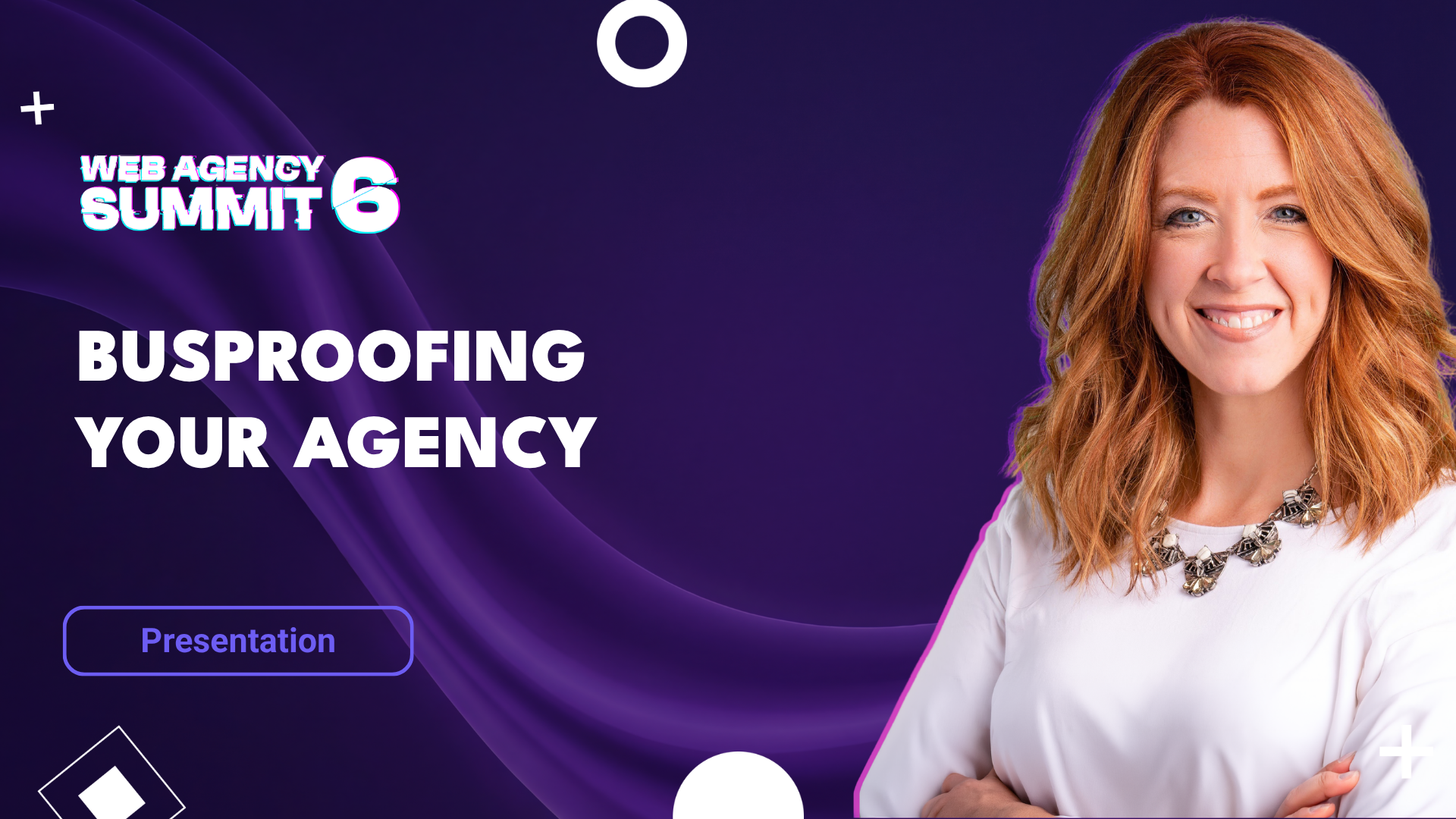
In this session, Steph Hudson — co-host of the Web Agency Summit and founder of FocusWP — delivers a candid and personal talk about the critical need for agency owners to have a "Hit by a Bus" plan. Drawing on her own near-death experience in Chicago in September 2023, where she was hospitalised in a coma on life support, she illustrates in real terms what it means for a business to lose its owner unexpectedly — even temporarily.
The central argument is straightforward: most agency businesses are entirely dependent on their owner's presence. Without a plan in place, even a few days of absence can result in missed client meetings, stalled projects, lost revenue, and significant financial damage. Steph does not advocate for a fully comprehensive business continuity plan, but rather a minimal viable system focused on the first 72 hours — enough to keep things running until the owner returns or until more help can be arranged.
The session introduces a simple three-part framework — People, Access, Direction — built around two key roles: the PAL (Personal Alert Lookout) and the DEX (Designated Executor). Steph also offers a downloadable starter kit with templates to help agency
owners get this plan in place quickly, with the assertion that an afternoon is all it should take.
Key takeaways
- 01Having a team is not the same as having a plan. If people do not know what to do in your absence, having staff does not protect your business.
- 02Two-factor authentication codes stored only on your phone represent a critical single point of failure. Move authenticator codes to a password manager immediately so they can be delegated.
- 03The sent box of your email is far more useful to a stand-in than the inbox. Instruct any deputy to review the last four to six weeks of sent mail to understand active commitments and communications.
- 04You need two specific people identified before anything else: a PAL (Personal Alert Lookout) from your personal life who will notice if something goes wrong, and a DEX (Designated Executor) who will act on your behalf in a business context.
- 05The PAL and DEX should be introduced to each other so the handoff in a crisis is clear and trusted, not chaotic.
- 06A full disaster recovery plan is not necessary. Borrowing from the Red Cross model of 72- hour emergency preparedness, the goal is to keep things running for just the first few days.
- 07The three pillars of a Hit by a Bus plan are People (who will act), Access (can they log in and operate), and Direction (do they know what to do).
- 08A brief screen-recorded video walkthrough of your key systems is one of the most practical tools you can create for your DEX — it conveys context that a written document cannot easily replicate.
- 09Getting this plan in place also unlocks positive outcomes: it makes genuine delegation easier and makes taking a vacation actually possible.
Introduction and Context
The session opens with a warm, informal exchange between Steph Hudson and the summit host, Vito Peleg, who are long-time friends and colleagues. Vito describes Steph as his "BFF"
and notes they have a long history together, including a helicopter trip to Las Vegas. The 01 02 03 04 05 06 07 08 09
tone is relaxed and comedic, with jokes about Steph's habit of running late and some mild technical difficulties getting her slides to load.
Vito briefly references the incident that forms the backbone of the session — alluding to nearly losing Steph — before stepping back to let her present. This sets up the personal story that will anchor the talk.
The Core Question: What Happens If You Disappear?
Steph opens her presentation with a reframe of the familiar "hit by a bus" concept. She notes that people often treat this phrase as shorthand for death, but that is not quite right.
There are many situations that do not kill a person but do take them fully out of commission — temporarily or for a prolonged period.
She asks the audience to imagine a gentler version of the scenario: what if, at the end of this session, you closed your laptop, unplugged your Wi-Fi, put your phone in a drawer, and disappeared into the woods for a week without telling anyone? Just one week. What would the fallout look like?
She walks through the likely consequences of that first month unplanned:
- An inbox full of unread emails.
- Multiple ghosted meetings with clients and collaborators.
- A client site potentially going down with no one to respond.
- A malware alert with no one to act on it.
- A team with no clear direction on their daily tasks.
- Team members who are themselves sick or unavailable, with no backup.
- If the first of the month falls in that window, paychecks may not go out.
- No one sending invoices, meaning no revenue coming in, with the bank account beginning to drain.
Steph's point is not to alarm the audience, but to illustrate why agency owners rarely take proper vacations, because the business is too dependent on them being present for it to function without them. She acknowledges that everyone knows this plan is necessary, but it never feels urgent because it is always a hypothetical. Real client work always takes priority over preparing for a "what-if."
Steph's Personal Story: Chicago, September 2023
The heart of the session is Steph's own story. She describes a trip to Chicago in September 2023 for a work visit, during which she also organised a meetup of her Facebook group, "Focus on Your Biz." She shows a photo from the event, noting that several of the people
present — including Andrew Palmer and Ron Johnson — are also participants in the Web Agency Summit.
Two days after that happy gathering, instead of boarding a plane home, Steph ended up in a coma on life support. She describes the situation frankly: all of her body's systems had effectively shut down. She required dialysis. She was on breathing assistance. When she eventually began to recover, she had to relearn how to walk, initially requiring two people supporting her at the same time. She was taken through the airport in a wheelchair.
Even when she returned, she was not truly back. Her brain was foggy for an extended period. Her stamina was gone. And critically, her business had not paused while all of this was happening.
The aftermath was significant: Projects went over scope and cost her thousands of dollars, because the written scope was not clear enough for the person who had stepped in to take over Clients were left waiting Work was floundering Steph is clear that she was not without support. She had a business partner, a trusted assistant, and a team. But she emphasises the lesson: having people is not the same as having a plan. Her business partner had a different role within the company and did not know the specifics of her day-to-day operations. Her assistant lacked the autonomy and information needed to make decisions in Steph's absence. No one really knew what Steph knew or did.
She also recounts a specific and telling problem with access. No one knew the passcode to her phone — not a single other person. This meant no one could access two-factor authentication codes, which blocked entry to bank accounts, email, and other critical systems. Even when Steph herself regained some consciousness, her brain was so impaired that she gave her parents the wrong code repeatedly. Eventually she bricked her own phone trying to get into it, making things worse.
Other Scenarios That Qualify as "Being Hit by a Bus"
Steph is careful to note that her story is an extreme case and that most people will not experience something that dramatic. She uses it not to frighten the audience, but because she learned her lessons the hard way and can now pass them on. She then walks through several other real-life examples to broaden the concept: Christina Romero (WP Care Market): Had a course about to launch on a Monday. On the Friday before, she was admitted for emergency gallbladder surgery. She had been editing the course videos all week and planned to finish them over the weekend. She ended up in a hospital bed, being wheeled down a hallway, on the phone trying to give a colleague her
password and ask them to email her list. A stressful and chaotic situation that a plan would have made far easier.
Abby (digital nomad): Abby and her husband lived and worked from their RV as digital nomads. They went for a hike, came back, and everything they owned — including all their work equipment — had burned. They lost their MacBook, all their files, and all their possessions. This was sudden, total, and left them entirely unable to operate their business.
Tom: Had two weeks' notice before brain surgery. Despite having advance warning, the emotional weight of the situation — fear for his own life, concern for his family — meant he was not in a state to sit down and calmly prepare a business continuity plan. He went into the surgery without one.
John: His pregnant wife suddenly became dangerously ill. They lost their baby. John told Steph that he was unable to think clearly or work at all for 17 weeks because of the grief and devastation this brought to his family. There was no medical emergency affecting him directly, but he was completely unable to operate his business.
Anna: Had to take emergency custody of her two-year-old granddaughter overnight. Her entire set of priorities changed instantly, and her capacity to manage her agency was fundamentally disrupted.
Steph also notes that not all disruptions are personal. Natural disasters — floods, tornadoes, wildfires — can knock out communications and internet access for extended periods. These too would qualify as a "bus hit" in the context of this system. The common thread across all these scenarios is: you are not there, and the business does not run without you.
What Went Wrong: A Breakdown of the Key Failures
Steph briefly recaps the specific categories of failure she experienced or observed, using her own situation as the reference point: Access: No one knew her phone passcode. This locked everyone out of two-factor authentication codes, which in turn blocked access to banks, email, and other critical systems. This was the single biggest and most avoidable problem.
Direction: Even with access, there were no clear instructions for what to actually do. People had logins but no map for using them effectively.
Missed meetings and deadlines: This affects client trust even when the reason is completely understandable. Clients who are not contacted and do not receive an explanation are left feeling abandoned, and it damages confidence in the agency.
Sent box vs. inbox: One of the more practical observations from the experience: trying to navigate someone else's inbox is effectively impossible. You do not know who the clients are, what is spam, what is already handled. The sent box, by contrast, is a record of real, active
communication and ongoing commitments. Anyone stepping in for an absent agency owner should go to the sent box first.
You do not know who the clients are, what is spam, what is already handled.
The 72-Hour Framework
Steph introduces her guiding principle for the plan: the Red Cross model of disaster preparedness. Emergency organisations like the Red Cross do not advise people to prepare for every possible scenario or stockpile a year's worth of resources. Instead, they recommend preparing for the first 72 hours, because in most situations, within three days, either help arrives or the situation stabilises enough to begin functioning again.
Steph applies this same lens to business continuity. The goal is not a comprehensive operations manual that covers every conceivable situation. It is a system that is simple enough to actually be created, and robust enough to keep the business running for a few critical days while the owner gets back on their feet or while someone figures out what the longer-term situation looks like.
She calls this the HBAP system — the Hit by a Bus Plan — and notes that this name has stuck across many conversations on the topic.
The HBAP Framework: People, Access, Direction
Step 1: People
The first and most foundational element is identifying the right two people.
The PAL — Personal Alert Lookout This is someone from your personal life: a family member, a close friend, a neighbour — someone who is in close enough contact with you that they would notice, relatively quickly, if something were wrong. The PAL does not need to be connected to your business at all. Their sole function is to send up a signal flare.
Steph addresses the alternative of using automated "dead man's switch" services — systems that require you to periodically confirm you are okay, and which trigger alerts if you fail to respond. She notes that these are risky, because forgetting to respond to a check-in email while you are busy could trigger a false alarm. A real person who knows you is more reliable.
The PAL just needs to know who to call. They do not step into your business. They observe and alert.
The DEX — Designated Executor The DEX is the person who actually carries out the plan. The name is borrowed from estate law: an executor of a will is someone who ensures the deceased person's wishes are carried out. In this context, the DEX is the person who — when the PAL signals that something is wrong — steps into the operational role and follows the instructions that have been prepared.
Steph emphasises that both people need to be identified before anything else, and they need to be introduced to each other. The PAL needs to know who the DEX is so they can make the right call. The DEX needs to know who the PAL is so they recognise the signal as legitimate and not a random person asking them to take over someone's business.
These conversations should be real, substantive ones. You want to explain what you would consider to be a triggering event. You want to make sure both people are genuinely willing to take on these roles. And Steph recommends offering to reciprocate — to serve as their PAL or DEX in return.
Step 2: Access
Access is described as one of the trickiest elements, and also the most critical. If the DEX cannot log in, they cannot help.
The key recommendations here are: Use a password manager with emergency access features. All of the major password manager tools have some form of emergency access or shared vault functionality. Steph is not prescriptive about which tool to use — whatever you already have, stick with it — but investigate what that tool offers for emergency delegation. Make sure it is configured properly.
Move two-factor authentication off your phone. This is the most emphatic specific technical recommendation in the talk. If your 2FA codes are arriving via SMS to your phone, or are in an authenticator app that lives only on your device, then your phone becomes a catastrophic single point of failure. Steph recommends switching to an authenticator that lives within your password manager, so that the codes can be accessed by anyone with authorised access to the vault. She acknowledges there are security discussions to be had around this approach, but stands behind it as the right tradeoff for most agency owners.
Step 3: Direction
The third element is ensuring the DEX actually knows what to do once they are in. Having access to systems is useless without context.
Steph recommends creating a brief set of instructions. These do not need to be exhaustive.
They should cover: Who needs to be contacted in the first 24 to 72 hours
What to tell clients if asked about your absence What absolutely cannot wait or be ignored for a week Where the list of active clients lives Any unintuitive system or piece of information that a stranger would struggle to find She specifically recommends recording a short video walkthrough of your key systems as you go about your day. Turn on a screen recorder while you are working and narrate what you are doing. This gives your DEX visual context that is much harder to convey in a written document.
She also reiterates the sent box recommendation in this context: tell your DEX, as part of their instructions, to go to your sent mail and review the past four to six weeks before trying to work through the inbox.
The Emotional and Family Dimension
Steph makes an important point that sits outside the purely operational framing of the rest of the talk. During her own experience, her family was sitting by her hospital bed not knowing if she would survive — and on top of that, they were also trying to figure out how to deal with her business, her bills, and the practical concerns that were piling up because nothing was in place.
She is explicit that this is not something we should put our families through. A family in a moment of crisis should be focused on the human situation — on the person they love — not scrambling to find passwords, figure out who the clients are, or decide whether to send a client invoice. Having a plan is, in this sense, an act of care for the people who matter most to you.
Having a plan is, in this sense, an act of care for the people who matter most to you.
The Starter Kit and Next Steps
Steph closes the session by pointing audience members to a free downloadable starter kit, available at focuswp.co/busproof (also accessible via a QR code shown on screen). The kit includes templates and instructions for setting up the key pieces of the HBAP system, including what to send to your PAL and what your DEX needs to know in the first critical hours.
She estimates that with these resources in hand, the whole plan can be put together in an afternoon. She encourages the audience to treat it as a weekend project rather than something that needs to be deferred indefinitely.
Steph closes with a reframe of the session's tone: this is not about fear, and it is not about expecting bad things to happen. It is about making sure the business can survive if the owner cannot be present for a period of time. And as a practical bonus, she notes, getting these systems in place also makes it easier to genuinely delegate work on an ongoing basis and to actually take a real vacation — both of which are things most agency owners struggle with.
Q&A and Close
There was not time for audience questions, as the session ran slightly over schedule. Vito noted there were positive comments in the chat from viewers sharing concern and gratitude for Steph sharing her story, including from people who were actually present at her bedside during the Chicago hospitalisation and had tuned in to hear the session.
Vito left the QR code on screen through the transition to the next segment, and noted that Steph would be taking over as co-host approximately an hour later in the programme.
 About the speaker
Steph Hudson
Founder, FocusWP
About the speaker
Steph Hudson
Founder, FocusWP
Steph Hudson is founder of FocusWP, an agency focused on WordPress support and maintenance. She is known for her work on business continuity planning for small agencies and freelancers.