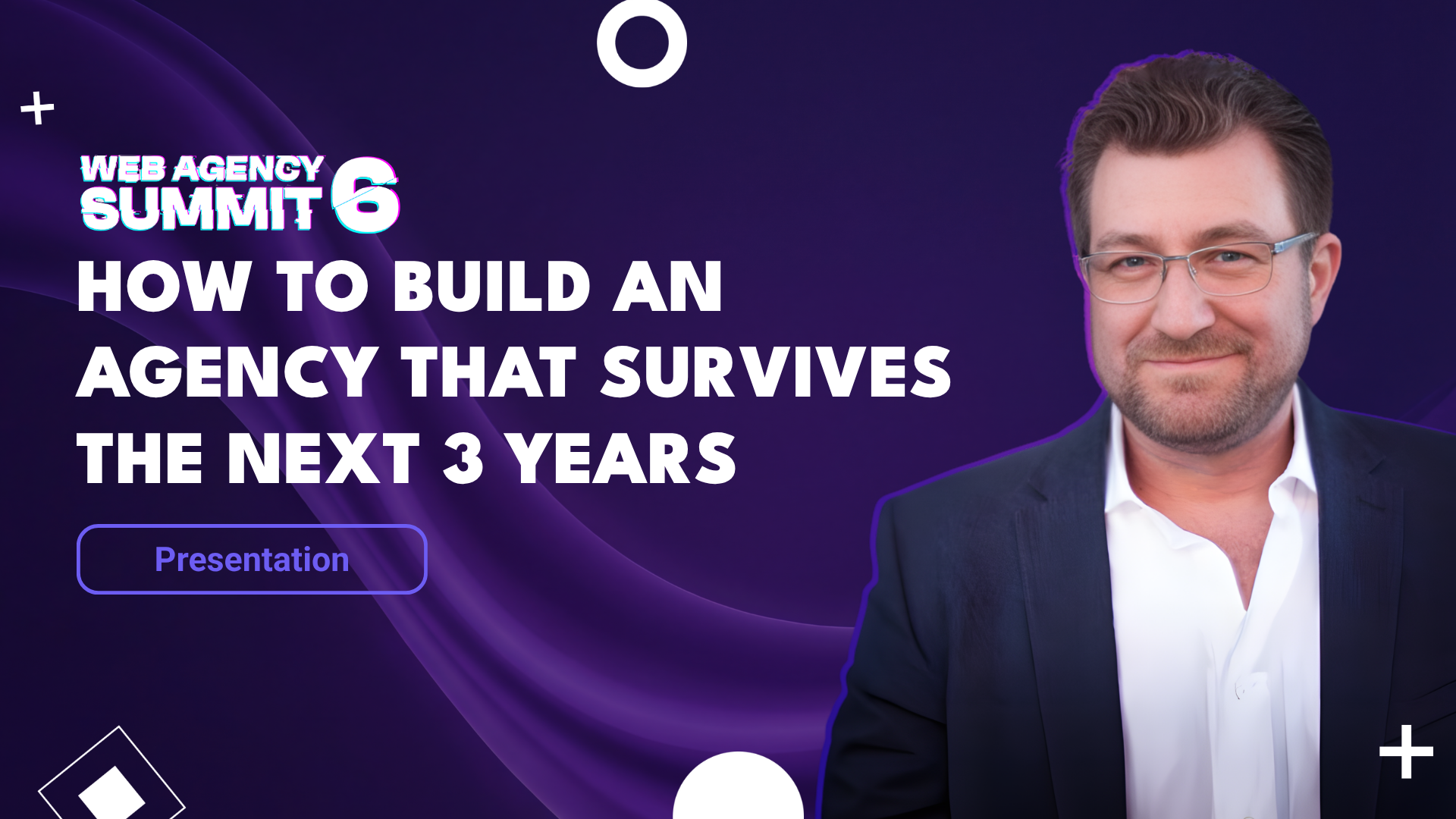
Karim Marucchi, CEO of Crowd Favorite — the original enterprise WordPress agency — delivered one of the summit's most operationally dense sessions, drawing on over three decades in the industry to explain why agencies consistently hit a wall around the 15- person mark and what it takes to push through it.
The core argument is deceptively simple: what makes a small agency successful will actively destroy a growing one. The scrappy, founder-driven hustle that gets you to eight or ten people creates structural fragility that becomes fatal as headcount climbs.
Beyond the 15-Person Death Spiral: Why Growing Agencies Fail and How to Build One That Survives the Next 3 Years Agency Insights Playbook 189
Margins erode, clients become over-concentrated, retainers turn into traps, and founders become bottlenecks without realising it.
Marucchi's prescription is equally clear: build a management layer with distinct accountability roles (account lead, delivery lead, and a practice or operations lead), move from task management to culture and outcome management, stop measuring success by headcount and start measuring revenue per head, and resist the temptation to treat AI as a strategy rather than a tool.
Throughout the session, Marucchi is candid about his own failures, including merging two agencies with clashing cultures, managing teams of nearly 500 people in his twenties, and openly admitting that Crowd Favorite is currently just below its own benchmark for financial reserves. The result is a session that functions less as inspiration and more as a practical diagnostic — and a checklist for agency owners who want to know exactly what is going wrong before it becomes fatal.
Key takeaways
- 01The 15-person threshold is not arbitrary. It is rooted in Harvard Business Review research on how personal relationships and informal communication break down at this scale, forcing role specialisation that many founders resist.
- 02Headcount is a vanity metric. The correct measure of agency health is revenue per head — Marucchi's target is 3x average cost per head, with 2x being the point at which agencies begin building meaningful reserves.
- 03No single client should represent more than 12% of revenue. When a client exceeds this, the answer is not to hire faster — it is to partner with another agency and diversify, because retaining the client matters more than capturing all the revenue.
- 04The founder is usually the biggest obstacle to growth. The instinct to hire people who think like you reproduces your own blind spots. The fix is to hire for your weaknesses, and then genuinely get out of the way.
- 05Retainers without structure create lazy teams. A recurring revenue contract must include quarterly business reviews, defined deliverables, executive check-ins, and explicit conversations about what falls outside the retainer scope.
- 06Three distinct leadership roles are essential for healthy delivery. An account lead owns the client relationship and long-term revenue; a delivery lead owns the current project SOW; and an operations or practice lead owns internal team health and process. These roles should be in productive tension with each other — not in a reporting hierarchy.
- 07The two-week vacation test is a reliable diagnostic. If you cannot step away for two weeks without the agency breaking, you have not yet built a functioning management layer.
- 08AI is a tool, not a strategy. LLMs accelerate production but cannot generate original strategy. Agencies that invest AI savings into upfront discovery and QA will outperform those that use AI to simply do more of the same faster.
- 09Onboarding must be deliberate and expensive. New hires should have a dedicated buddy, near-constant contact in the first 90 days (including video presence when remote), and should not be billed to client projects during that period.
- 10Distributed teams require intentional culture-building. Crowd Favorite has operated as a distributed company since 2014 and reserves Fridays entirely for internal work, learning, and exploration — no client meetings, no billable work.
The Core Problem: Why Agencies Fail at 15 People
What the 15-Person Number Actually Means Marucchi was careful to clarify that 15 is not a magic number for every agency. The actual threshold can appear at 8, 10, 12, or 15 people, or at the one-to-two million dollar revenue mark, depending on the structure of the business. What the number represents is the point at which informal communication and personal relationships between team members break down.
He cited Harvard Business Review research as the basis for this, noting that up to approximately 15 people, a team can operate on personal trust, direct communication, and shared context. Beyond that point, people start stepping on each other's feet without defined lanes. Hats that the founder used to wear simultaneously now need to be assigned to dedicated individuals, and the agency needs structure to replace the informal glue that held it together at smaller scale.
The problem is that most agency owners do not recognise this transition happening. They continue to operate as they did at five or eight people, which means they continue to be the central node through which every decision flows. This creates a structural bottleneck that compounds as the team grows.
The Hustle That Got You Here Will Kill You Marucchi is direct about this: the instincts and behaviours that produce success at a small agency become liabilities at a larger one. The ability to improvise, to personally solve every client problem, to hold the entire context of every project in your own head — these are assets at ten people and active problems at twenty.
He described his own love of improv and going off-the-cuff with clients, then acknowledged that growth requires building "deep process" in place of that improvisational instinct.
Process is what creates clear outcomes instead of constant drift. The goal is not to eliminate creativity but to build a scaffolding that lets creativity operate at scale without depending on the founder's personal attention.
Revenue Concentration and the Client Mix Problem
The 12% Rule One of the most concrete rules Marucchi offered is what he calls a hard and fast rule at Crowd Favorite: no single client should represent more than 12% of total revenue. When a client approaches or exceeds this threshold, the instinct for most agencies is to staff up aggressively to service that account. Marucchi argues this is exactly the wrong response.
Instead, Crowd Favorite's approach is to bring in a partner agency that specialises in what the client needs, rather than hiring internally to capture all the revenue. The reasoning is straightforward: if that client represents 40 or 50% of your revenue and something changes — inside or outside their control — the agency is in serious trouble. The goal is to retain the relationship and diversify the revenue base, not to maximise the take from any one account.
This approach also signals to the wider market that the agency is a trustworthy partner rather than a competitor, which feeds the broader partner ecosystem described later in the session.
Hockey Stick Growth Is a Warning Sign Marucchi made a counterintuitive point about rapid agency growth: sophisticated enterprise clients view it with suspicion. If they see an agency growing too fast, they interpret this as instability — a sign that the agency may be over-stretched, under-systematised, or building on a shaky foundation. The image Marucchi offered is of growth that looks like a staircase rather than a hockey stick. Incremental, consolidated progress is more attractive to the kind of long-term clients Crowd Favorite pursues.
The Technology Trap and Scope Creep
Falling in Love With Technology Marucchi described a pattern he calls the "good idea fairy" problem, which he admits to having experienced personally. As an agency tries to become more scalable, it often latches onto a specific technology and begins defining all client work through that lens. The logic is that if you deliver the same thing again and again, you can build repeatability.
The problem is that the client's actual problem gets subordinated to the agency's preferred solution. When the client then asks for something slightly different or adjacent, the agency either refuses (limiting the relationship) or says yes and begins stretching horizontally across too many capability areas. Both paths are dangerous. The solution is to stay anchored to the client's problem, not to the technology, and to partner for anything outside your core competency.
Specialisation and the Partner Ecosystem Crowd Favorite's own answer to this is to specialise in architecture and system builds. This means the agency sometimes hands off the actual build work, content production, SEO, marketing, or design to partners rather than doing everything in-house. This is a deliberate strategic choice, not a concession.
The partnership model creates multiple benefits: it keeps the agency focused on what it does best, it generates an inbound pipeline from other agencies, and it positions Crowd Favorite as a collaborative partner rather than a direct competitor. Marucchi described the partner ecosystem as one of Crowd Favorite's active business development pipelines.
On white labelling specifically, Marucchi was emphatic: do not do it. Clients almost always find out, and when they do, the relationship suffers. His advice is to be transparent about partnerships, explain why you trust the partner, and show the relationship openly.
Transparency protects the client relationship in a way that white labelling never can.
Retainers, Recurring Revenue, and the Rhythm of Delivery
Why Retainers Without Structure Fail Marucchi challenged the common agency wisdom that retainers are the holy grail of revenue. His concern is not with retainers as a billing vehicle but with what they often become in practice: a way for teams to coast. Without defined deliverables, check-ins, and renewal conversations built into the retainer structure, the team loses its sense of urgency and the client loses confidence in the value being delivered.
He described the danger as "blind retainers" — contracts that create the appearance of recurring revenue while quietly eroding margins and client relationships underneath.
What Recurring Revenue Should Actually Look Like The distinction Marucchi draws is between retainer as a billing strategy and retainer as a delivery model. You can have a multi-year contract with monthly or quarterly payments while still running it with the rigour of a project: quarterly business reviews, defined deliverables, cadenced executive check-ins, and explicit conversations about what falls outside the existing scope and requires a separate project.
This structure also creates the space for the account manager to have forward-looking strategic conversations with the client, rather than simply reporting on what was done this month. The retainer becomes a programme rather than a standing order.
He also acknowledged that some clients prefer an ad hoc arrangement — a higher billing rate in exchange for the ability to pick up the phone and request help at any time, even after months of silence. Crowd Favorite accommodates this too. The point is not to force every client into one model but to ensure that whatever model is used has the structure and accountability built in.
The Management Layer: The Three-Role Framework
The Core Problem With Founder-Led Delivery Marucchi returned repeatedly to the idea that founders are the most common cause of their own agencies' failure to scale. Not because they are bad leaders, but because they continue to give tasks rather than transmit culture. The distinction matters enormously: a team that has been told how to do task X is helpless when task Y arrives. A team that has been given the framework and culture for how to solve problems can handle both.
The test he offered is simple: what happens if you are unreachable for two weeks? Not what happens if you slow down or are less available — what breaks entirely if you are genuinely gone? The answer tells you whether you have built a management layer or whether you have just hired more people who report to you.
The Account Lead The account lead owns the client relationship and the long-term strategic success of that relationship. They are responsible for revenue from the client over time and for understanding what the client actually needs, sometimes beyond what they have specifically requested. In Crowd Favorite's model, the account lead is distinct from the delivery team — they are thinking about the health of the relationship, not the execution of the current project.
Marucchi noted that in many cases he serves as the executive sponsor of accounts, appearing at quarterly reviews and important strategic meetings, while the account lead owns the day-to-day relationship. This is the model he advocates for: founders and CEOs as executive sponsors, not account owners.
The Delivery Lead The delivery lead is responsible for the current SOW — the specific project being executed.
Their focus is narrow by design: does this project get delivered on time, within scope, and to the standard agreed? Crucially, this focus can put them in tension with the account lead, who may want to add scope or pursue strategic opportunities that affect the current delivery.
Marucchi argued that this tension is healthy and should be preserved. The delivery lead should be willing to push back on the account lead when new requests threaten the project.
This is not a management failure — it is the system working correctly. The two roles should not be collapsed into one, and the delivery lead should not report to the account lead.
The Practice or Operations Lead The third leg of the stool is someone who, as Marucchi put it "doesn't care about the delivery of the project and doesn't care about revenue." Their job is to care about the team: are the practices healthy, is the team developing, is the documentation being maintained, are internal processes being followed and improved?
At Crowd Favorite, this role is filled by the Director of Operations, Angela Palmer, whom Marucchi described with clear affection as "mom dragon" — someone who will call out anyone making the team suffer internally. The operations lead should be in productive conflict with both the account lead and the delivery lead, because she is optimising for a different outcome: team sustainability and internal excellence.
Implementing This at Small Scale A question from the audience asked how to implement this three-role framework with a small team. Marucchi's answer was practical: even at six people, identify the three individuals who will be responsible for these three outcomes, and build time for those responsibilities into their working week explicitly, including calendar time. The roles do not Beyond the 15-Person Death Spiral: Why Growing Agencies Fail and How to Build One That Survives the Next 3 Years require three full-time people dedicated exclusively to them — they require three people who are consciously accountable for each area.
Hiring: The Most Common Mistakes and How to Fix Them
Do Not Hire Your Own Clone The instinct when scaling is to hire someone who thinks like you, has your background, and shares your instincts. Marucchi argues this is exactly wrong. When you hire yourself, you hire your own blind spots. To actually scale, you need people who cover your weaknesses, not your strengths.
Do Not Hire Too Far Ahead The opposite mistake is hiring someone with experience at a much larger scale than you currently operate. Marucchi described this vividly: someone who has managed a management layer at 50 people will not function well inside the informal structure of a 15- person agency. They are used to infrastructure that does not exist yet, and no matter how talented they are, you cannot create that infrastructure fast enough to support them.
The right hire is someone who can grow with you, or someone who is one step ahead of where you are — not three steps ahead. He illustrated this with the example of agencies trying to hire talent from large San Francisco tech companies, noting that these hires consistently struggle with the realities of small-team operations.
The 90-Day Onboarding Protocol Crowd Favorite's onboarding system is intentionally intensive. Every new hire is paired with a buddy for their first 90 days. If the team is remote, that buddy maintains near-constant video contact during working hours — not just in meetings, but as a background presence.
The new hire is not billed to any client project during this period.
Marucchi acknowledged this is a heavy cost. It means the agency cannot simply onboard someone and put them straight to work generating revenue. But he sees it as essential for building genuine competency and cultural fit, and it is part of why he recommends a strong partner ecosystem — so the agency can supplement capacity during onboarding periods without compromising client delivery.
To actually scale, you need people who cover your weaknesses, not your strengths.
The Revenue Per Head Framework
Why Headcount Is a Vanity Metric Marucchi was forceful on this point: the common agency habit of measuring success by how many people you employ is misleading and dangerous. The real measure of agency health is revenue per head — total revenue divided by total headcount, including administrative and non-billable staff, including the founders' own salaries.
The target he set is 3x the average cost per head. He immediately acknowledged this is very difficult to achieve. The more practical benchmark, drawn from his experience evaluating agencies for WPP acquisition, is 2x cost per head — the point at which an agency begins building meaningful financial reserves.
The Three-Quarter Survival Test Marucchi offered a specific and memorable benchmark for financial resilience: if all client invoices stopped arriving tomorrow — not gradually, not through a wind-down, but cold — how long could the agency survive? His benchmark is three quarters. That level of reserve is what he considers genuinely healthy.
He was disarmingly honest about Crowd Favorite's current position: the agency is just below this mark right now, following a difficult Q4 and Q1 during which enterprise clients were paralysed by uncertainty about AI's implications for their businesses. He noted that this is the first time in 12 years they have fallen below the benchmark, and that they are not panicking because they have the systems and the history to navigate it.
AI: The Correct Role in an Agency's Future
Why AI Is Not a Strategy Marucchi closed his prepared remarks with an extended section on AI, framing it as the most exciting development in technology since the mid-1990s, when new tools were appearing daily. But his core argument is a corrective to the hype: AI is a tool, not a strategy, and the reason clients hire agencies is for thinking, not for execution.
He made the point that LLMs cannot generate original strategy. Even when prompted with your own ideas, they tend to homogenise — producing outputs that are technically coherent but strategically undifferentiated. Original, defensible client strategy is precisely what agencies exist to provide, and it is the last thing AI can replicate.
The Hourglass Model: Front-Load Discovery, Back-Load QA Marucchi described what he calls an hourglass model for AI-augmented agency work. If AI reduces your development cycle by 50 to 80%, the correct response is not to pocket all of that saving as margin or to take on more work at the same quality. Instead, he recommends Beyond the 15-Person Death Spiral: Why Growing Agencies Fail and How to Build One That Survives the Next 3 Years reinvesting half of the time saved into the front of the funnel (discovery, intent, digital strategy) and into QA at the back.
On QA specifically, he extended the concept beyond technical testing. Before handing anything to a client, the question is not just "does it function?" but "does it actually solve the problem?" He argued that AI-generated outputs will pass functional QA while frequently failing strategic QA, because they are not grounded in the client's specific context and intent.
The Opportunity for Agencies The net effect of this argument is that agencies that can do serious upfront strategy and rigorous QA will be more valuable in an AI-augmented world, not less. The commodity part of the work — raw production — is the part AI handles well. The non-commodity parts — understanding what the client actually needs, creating original strategy, and verifying that the output meets those needs — are where agencies need to concentrate their value.
Marucchi noted that Crowd Favorite already spends more time on intent and digital strategy than on the build itself, and expects this trend to continue. The agency's job is to ensure that clients who might use AI tools internally still need expert guidance on the thinking that shapes what those tools produce.
Even when prompted with your own ideas, they tend to homogenise — producing outputs that are technically coherent but strategically undifferentiated.
Surviving the Next Three Years: The Practical Checklist
Create Predictable Margins Through Process The path to financial resilience runs through operational process. Without documented, repeatable processes, every client engagement depends on key individuals' personal knowledge — which means margins depend on those individuals being available and not burning out. Process is what makes delivery predictable, and predictable delivery is what makes margins predictable.
Build Recurring Revenue That Does Not Depend on You Recurring revenue contracts are valuable, but only if the delivery underneath them is systematised. The goal is a revenue model where the money keeps arriving because the value keeps being delivered, and neither depends on the founder's personal involvement.
When the founder is the mechanism through which the client receives value, the agency has not actually built recurring revenue — it has built a personal services arrangement with a retainer label on it.
Create Silos and Pods That Can Deliver Independently Getting past 15 people means creating teams that can operate without the founders in the room. This requires defining not just roles but outcomes: not "what does this person do" but "what is this person responsible for achieving." Marucchi referred to this as managing for outcomes rather than managing by checklist.
The Monday Morning Exercise Marucchi closed his prepared remarks with a specific exercise for agency owners to run on their current client list. For each account: Who owns the outcome? What is the margin on this account? What would break if you were unreachable for two weeks? Running this analysis across all current accounts will surface the actual risk profile of the agency and identify where the structural problems live.
On Scope Creep and Teaching Teams to Handle It
Marucchi added scope creep management as a specific skill that founders need to actively teach their account managers and project managers, rather than assuming they will develop it naturally. His recommendation is direct: do role-playing exercises. He cited project managers who attended actors' studio sessions specifically to practise handling difficult client conversations, including the improvisational discipline of going with whatever the other person throws at you.
The point is not to teach a script but to build confidence and fluency in real-time negotiation. Scope creep conversations are uncomfortable precisely because they are unpredictable, and role-playing builds the muscle for navigating them without either caving to the client or damaging the relationship.
On Feedback, Career Paths, and Team Development
Continuous Feedback Loops Marucchi emphasised the importance of regular, ongoing feedback as a leadership skill in its own right. The challenge is learning to give feedback in a way that does not feel like constant criticism. Quarterly reviews, growth path conversations, and genuine investment in team members' development are not optional features of a healthy agency — they are part of what keeps people from leaving.
Non-Linear Career Paths One of the more nuanced points in the session concerned the assumption that good performers will naturally progress through a standard career ladder. Marucchi challenged this: someone who is excellent at project management is not necessarily going to be good at account management, and vice versa. Someone who is brilliant at strategy may be poor at Beyond the 15-Person Death Spiral: Why Growing Agencies Fail and How to Build One That Survives the Next 3 Years managing client relationships. Forcing people into roles they are not suited for because they have been with the agency for a long time is a mistake that costs the agency both the person and the role.
On Distributed Teams and Internal Culture
Crowd Favorite has operated as a fully distributed company since 2014, which gives Marucchi more than a decade of experience with the specific challenges of building culture across remote teams. His observations were practical: you need to create intentional time for both work meetings and social interaction, you need to get the team physically together periodically, and you need to budget the management overhead that distributed work creates. It does not happen by accident.
The Friday policy is one structural expression of this culture investment: the entire company reserves Fridays for internal work, learning, and exploration. Client meetings do not happen on Fridays. Client work does not happen on Fridays (except genuine emergencies). This protects time for the team to develop professionally and to engage with new tools and technologies — including AI — without the pressure of billable time.
On Selling an Agency and Preparing for Exit
Marucchi touched briefly on exit readiness, both from his experience at WPP and in the context of Crowd Favorite. The clearest signal of an agency worth acquiring is one where the founder has successfully transitioned from working in the business to working on it. An agency where the founder is the mechanism of delivery is not a business — it is a job with staff attached.
At Crowd Favorite, this transition is expressed through the chief of staff role. Marucchi's chief of staff is responsible for internal staff management, which frees him to work on strategic projects, maintain external relationships, and represent the agency at events like the Web Agency Summit. That division of responsibility is both a management model and, if the agency were to seek a buyer, a proof of concept.
He also noted that the single most common cause of agency failure he observed during his WPP acquisition work was founders or early leadership teams who could not get and stay on the same page. Not market conditions, not technology changes, not client churn — internal leadership misalignment, usually among the two or three people at the top.
Q&A Highlights
On the revenue-per-head target being hard to achieve: Marucchi acknowledged this directly and without qualification. 3x is the target, 2x is the point at which agencies start building meaningful reserves. He noted that most agency owners who run the calculation for the first time find they are netting less than they thought.
On enterprise clients and AI freeze: During Q4 of the previous year and early into 2026, many of Crowd Favorite's enterprise clients were frozen by uncertainty about AI. Some had legal departments prohibiting AI access from company networks entirely. Others were pushing for rapid experimentation. Marucchi's approach was to acknowledge the evolving nature of the technology, not to pretend certainty they did not have, and to emphasise the importance of planning and control.
On ad hoc contracts: Crowd Favorite does offer clients a higher-rate ad hoc arrangement for occasional access without a standing retainer. This works for clients who may go quiet for months and then need help urgently. The key is that the rate reflects the flexibility being offered.
On the single biggest thing that kills agencies: The founders or original leadership team failing to align. Second most common: founders who decide to prepare for sale and change their behaviour in ways that damage the culture and operations of the business.
 About the speaker
Karim Marucchi
CEO of Crowd Favorite
About the speaker
Karim Marucchi
CEO of Crowd Favorite
Karim Marucchi is CEO of Crowd Favorite, a digital agency that has operated as a distributed company since 2014. He writes and speaks widely on the operational and leadership challenges agencies face as they scale past their founding team.