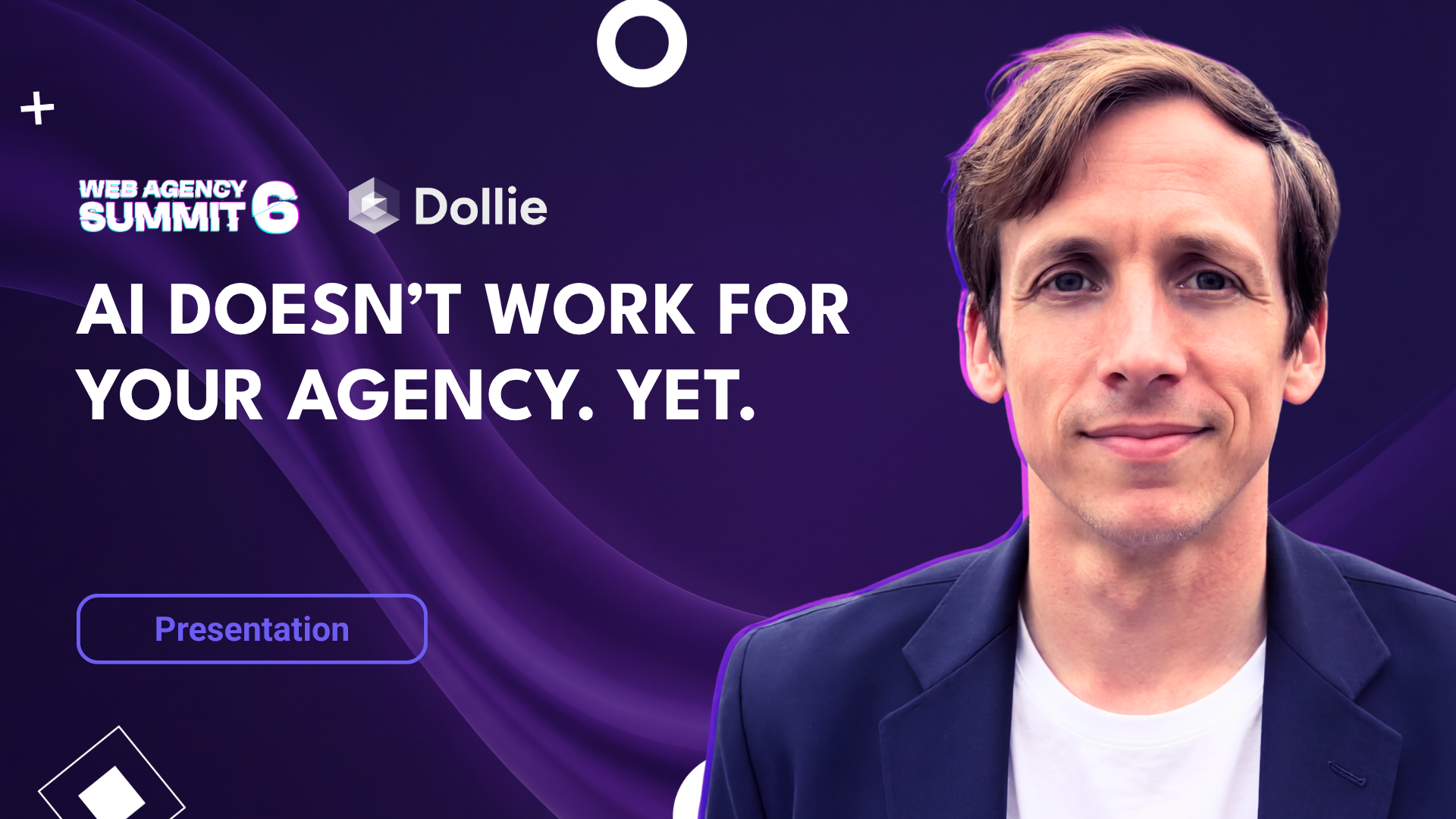
Bowe Frankema, co-founder of Dolly, delivered a session built around a deliberately provocative thesis: that AI, as most agencies currently use it, does not truly work for them. His argument is not that AI is ineffective in the abstract, but that generic AI tools deliver generic output, and that the 70% of work any AI model produces by default represents no competitive advantage for any agency.
The remaining 30%, the part that actually determines whether an agency succeeds or fails, depends entirely on what Frankema calls "agency brain": the accumulated processes, taste, standards, client history, and institutional knowledge that makes each agency distinct. The central argument of the session is that agencies need to deliberately engineer and maintain that context, making it available to AI agents in a structured, dynamic, and persistent way. Without that, they are simply producing AI slop at speed.
Frankema introduced Dolly, a product his team spent 18 months building, as a "context layer" and "HQ for the AI era." Dolly allows agencies to build and maintain an agency brain that connects via MCP (Model Context Protocol) to any AI tool, from Claude and ChatGPT to Lovable and Codex, so that every agent working on behalf of the agency
draws from the same shared, up-to-date knowledge base. He also touched on the broader question of how agencies and smaller products will remain discoverable in an AI-driven world, and closed with a live product demonstration.
Key takeaways
- 01AI currently delivers roughly 70% of what any agency does, and that 70% is freely available to everyone. The last 30% is where agency survival lies.
- 02That final 30% is made up of your aesthetic judgment, your client history, your scoping standards, your voice, and your delivery processes. This is what Frankema calls the "agency brain."
- 03Context engineering is the practice of deliberately capturing, maintaining, and exposing that agency brain to AI agents. The term is fashionable but the concept is straightforward.
- 04The simplest starting point is a single markdown file that describes how your agency works, built by having an AI interview you in voice mode until it understands your processes, brand, ideal client, and team culture.
- 05Static context files are a foundation, not a solution. Dynamic context, pulled live from your CRM, client emails, WordPress sites, and other systems, is what makes agents genuinely useful day to day.
- 06The agency loop that the most successful agencies have mastered is: gather context on the fly, make it available where you work, deliver, remember what you delivered, and repeat.
- 07One brain connected to many tools, via MCP, means no re-explaining, no manual handovers, and no context loss when switching between Claude, Cursor, ChatGPT, Lovable, or any other tool.
- 08Agents can move from reactive to proactive once context is always live. You can schedule proposals, daily updates, weekly WooCommerce reports, and other recurring deliverables rather than triggering them manually each time.
- 09Dolly is opening early access and is actively looking for agency feedback to shape the product. The founding team is building it with agencies, not just for them.
Introduction and Session Framing
The session opened with some light technical confusion as Frankema confirmed he could be seen by the audience. Host Stephanie Hudson introduced him while briefly fumbling his name, something Frankema graciously acknowledged is common even in the Netherlands 01 02 03 04 05 06 07 08 09
where he is from. He clarified that the easiest pronunciation is to think of David Bowie and say "Bowie."
Frankema noted that his title, "AI Doesn't Work for Your Agency. Yet." was chosen deliberately to be provocative. He acknowledged that viewers would land in one of two camps on seeing it: either dismissing him as someone claiming AI does not work, or recognising that there might be something meaningful beneath the bold claim. He confirmed it was the second reading he intended, and set up his thesis accordingly.
He also flagged upfront that he would be doing live demonstrations at the end of the session, which he described as "probably the most dumb thing anyone can do in a presentation,"
given the risk of things going sideways. This framing established a candid, self-aware tone that ran throughout the talk.
The Core Thesis: The 70/30 Problem
Frankema's central argument is that AI tools available today, the major chat and completion models, are broadly accessible to every agency. Because the model itself is not a differentiator, it cannot be the source of competitive advantage. What can be a differentiator is everything you bring to the model: your processes, your taste, your standards, and the specifics of how your agency delivers work.
He illustrated this with a concrete scenario. Imagine onboarding a brilliant new hire who is super smart, fast, and eager to learn. You tell them: "Just make a proposal for Sarah."
Without knowing anything about Sarah, your agency's style, or your preferred scope format, they will produce something that is readable and structurally acceptable. The headers will be in the right place. But it will be entirely generic. Frankema was direct: "If this is your current process, you are in trouble."
He put a number on this. AI, by default, will get you about 70% of the way to what an agency does. That 70% is available to everyone. The final 30% is what makes an agency successful.
It is made up of aesthetic judgment, the history with the specific client, how the agency scopes and delivers particular types of work, whether that is WordPress, WooCommerce, Shopify, or something else, and what the agency ships and how it communicates.
The session was built around a practical framework for closing that 30% gap.
What Makes Up the Agency Brain
Frankema deliberately moved away from the phrase "context engineering," which he acknowledged is fashionable but abstract, and replaced it with a concrete label: "agency brain."
The agency brain is everything that makes an agency itself: its processes, its voice, its taste, its standards, its senior engineers' instincts, its thought leaders' judgments, and even the informal ideas that come from people walking into the office. These are things every agency
already has. The problem is that none of this is currently available to AI agents out of the box.
He drew a parallel to onboarding a new human employee. When you hire someone, you give them a company handbook. You walk them through client histories. You have them shadow the team. You give them access to your tools, whether that is HubSpot, Atarim, Dolly, or anything else. You provide documentation. You expose them to the conversations you have had with clients and with each other.
The question Frankema posed to the audience was: do you do the same for your agents?
Specifically, he asked whether agencies are providing agents with: Markdown files explaining how the agency works Client histories and relationship details Documentation of the processes the agency uses Conversations held with clients and internally Access to the external systems and software the agency runs He noted that if every answer is yes, the agency is in a good position and is probably already successful. If some of those are in place, there is room to build. If none of them are in place, that is what the talk was there to address.
You give them access to your tools, whether that is HubSpot, Atarim, Dolly, or anything else.
Starting Simply: The Markdown File
Frankema's recommended entry point for any agency that has not yet done any of this is a single markdown file. Markdown is human-readable plain text, and most AI tools can consume it directly.
He used "Mocha Inc." as a fictional agency name for the presentation, named after his dog, and used it to illustrate what a basic agency context file looks like: the agency name, what it does, how it works, who it serves, what its standards are.
His advice for creating this file was practical and low-friction. Open your preferred chat application, whether that is ChatGPT or Claude, turn on voice mode, and prompt it to interview you about how your agency operates. Tell it to keep asking questions until it understands your processes, your brand, your ideal client, and your team culture. Then ask it to write everything it has learned into a file, something like myagency.md or mochainc.md.
He made a particular point about using voice mode for this exercise. The organic back-and-forth of a voice interview tends to produce more natural, complete responses than typed
prompts, and the resulting file will better reflect how the agency actually works rather than how someone thinks it should be described in a document.
Tell it to keep asking questions until it understands your processes, your brand, your ideal client, and your team culture.
Moving from Static to Dynamic Context
Once a foundational markdown file exists, Frankema outlined several ways to use it and build on it.
The simplest method is copy and paste: put the agency file directly into a prompt. It works, even if it is not elegant.
A more structured approach is to turn the file into a skill, which most agents today can load automatically either when relevant topics come up in conversation or when explicitly called with a slash command.
For team-wide synchronisation, Frankema recommended Obsidian, a free application that can sync a folder across all team members' machines. This ensures that when any team member updates the agency brain, everyone else's agents automatically pull from the updated version. Dropbox or similar tools can serve the same function.
However, Frankema was clear that static files are only a starting point. The real power comes from dynamic context. Client situations change. Websites get updated. Emails arrive.
Processes evolve. A static markdown file becomes stale.
The solution is connecting the agency brain to live data sources: the agency's CRM, client email threads, WordPress sites, project management systems, analytics, and any other tools the agency uses day to day. When an agent can pull current data on the fly rather than relying on a snapshot, the quality and accuracy of its output increases dramatically.
He gave a practical example: if you are preparing for a call with a client named Sarah, instead of prompting the agent from scratch about who Sarah is and what you have done for her, you ask it to pull together a briefing. Because the agency brain is connected to live data, the agent can surface that three of her sites were recently updated, there has been no downtime, Lighthouse scores are strong, and WooCommerce orders are trending up. A fully accurate report, generated in minutes, without manual compilation.
The Three-Part Framework for Winning with AI
Frankema structured his argument around three components that agencies need to get right:
1. Build the agency brain. Capture everything that makes the agency distinct: processes, voice, taste, standards, team expertise, client histories. This is the foundation.
2. Make the brain available to agents. Gather context, keep it current, and expose it to the AI tools the agency uses through whatever integration method is available, with MCP being the most flexible current standard. This is what enterprise agencies are already doing, and what others should be working toward.
3. Be discoverable in the AI era. Frankema raised a concern that is on many agency owners' minds: as AI becomes the primary interface through which clients discover and engage with services, will smaller agencies remain visible? He argued yes, but only with deliberate effort. The same logic applies to the products agencies use. Smaller tools like Atarim and Dolly need to ensure they are discoverable and surfaced in AI-driven contexts.
He positioned this as a context problem as well, and flagged it as a significant and growing topic, though he did not go deep on it in this session.
The Agency Loop
Frankema described what he called the "agency loop" that the most successful agencies on the Dolly platform have figured out. It has four steps: Gather the right context on the fly, from live data sources connected to the agency brain.
Make it available wherever the team and agents are working, without manual handovers or re-explaining.
Deliver the work, using the full context to produce output that reflects the agency's actual standards and the specific client's needs.
Remember what was delivered, and repeat, so that the brain compounds over time and each subsequent job benefits from the history of what came before.
This loop is, in his framing, what separates an agency that uses AI as a generic shortcut from one that uses AI to genuinely amplify its institutional knowledge and deliver at ten times the output.
What Context Unlocks in Practice
Frankema gave a series of concrete examples of what becomes possible once an agency brain is properly built and connected: Client reports in minutes instead of hours. Because the agent has live access to site performance data, plugin statuses, and client history, it can assemble a complete and accurate report without any manual data gathering.
Site audits with full context. Audits can reference what the agency already knows about the site, the client's priorities, and previous work done, rather than treating each audit as if starting from scratch.
Proposals that reflect the actual relationship. Rather than generic project outlines, proposals can reference the specific history with the client, their known preferences, and the agency's particular approach to that type of work.
Actual project delivery. If an agency uses a tool like Lovable to launch a website, the agency brain can supply the context needed to ensure the output matches the agency's standards and the client's specifications, without manual briefing at each step.
Proactive, scheduled work. Once context is always available and current, agents can move from reactive to proactive. The agency can schedule agents to produce daily check-ins, weekly performance reports, or periodic proposals, offloading a significant portion of routine administrative and reporting work.
He also pointed to the Monday morning check-in as a simple but illustrative use case. You ask the agent how things look for the week. It queries the agency brain, pulls data on all clients and all sites, flags anything that needs attention, and produces a structured briefing that can be pushed directly to Slack or another communication tool.
Dolly: The Product
Frankema described Dolly as the agency's "HQ for the AI era." The core product concept is a context layer that sits between an agency's data sources and the AI tools the agency uses.
The build took 18 months. The fundamental design principle is one brain, many tools. An agency using Dolly gets its own MCP server. That server can be connected to any AI tool that supports MCP: Claude, Claude Code, Cursor, VS Code, ChatGPT, Gemini, Lovable, Codex, and others. Whichever tool an agent or team member is working in, it draws from the same agency brain, with no duplication, no re-explaining, and no context loss.
During onboarding, Dolly asks structured questions about the agency: its processes, its clients, the text and language it uses, its branding. This bootstraps the agency brain from the start.
The brain can then be connected to the agency's WordPress sites, CRM, notes, client history, and other external tools. As those sources update, the brain stays current. The dashboard also provides a traditional site management view, so agencies can still do conventional work like plugin updates, while their agents have simultaneous visibility into the same information and can act on it independently.
Frankema demonstrated this in a live product walkthrough. He showed a fictional agency called "Mocha Inc." with clients including Vito (of Atarim). In the Dolly interface, he initiated a conversation about drafting a proposal for a co-marketing campaign between Dolly and Atarim. Because Atarim and Vito were already in the agency brain as clients, the agent immediately had relevant context without any manual briefing.
He then switched to the Lovable tool and asked the same agent, now connected via MCP, which sites the agency managed for Vito and who the other clients were. Lovable pulled the
information from the agency brain directly. He then opened Codex and repeated the query, getting the same result from the same brain. The demonstration showed that the same context, once entered into Dolly, flows into every connected tool without any additional setup.
He noted a brief delay during the live demo, something he had pre-empted by describing live demos as "probably the most dumb thing anyone can do in a presentation," but the core functionality came through clearly.
The Discoverability Question
Frankema raised but did not fully develop a point about how agencies will be found and remain relevant as AI becomes the primary discovery and engagement layer for many services. He acknowledged this is a pressing concern for many agency owners, particularly smaller ones, and connected it back to the context theme. Making sure your agency and the products you use are represented correctly in AI-accessible contexts is part of building for the AI era, not just an afterthought.
He indicated this is something both Atarim and Dolly are thinking about actively but did not offer a complete framework for addressing it within the session's scope.
Closing Remarks and Audience Q&A
With two minutes left, Frankema wrapped up the demonstration and invited agencies to explore Dolly. He confirmed that early access was opening the following week, with a Discord community for feedback and direct engagement. He encouraged agencies to reach out via LinkedIn, X, or other social channels.
Host Andrew Palmer (who had been muted for much of the week and apologised for finally unmuting) and Stephanie Hudson closed out the session warmly. Hudson highlighted her favourite practical takeaway: the voice-mode interview technique for generating the initial agency markdown file.
The session ended with a reminder that Dolly can be found at gitdolly.com and that Frankema is actively seeking agency partners to shape the product.
 About the speaker
Bowe Frankema
Co-founder, Dolly
About the speaker
Bowe Frankema
Co-founder, Dolly
Bowe Frankema is co-founder of Dolly, a company building AI tooling for web professionals. He writes and speaks about context engineering, the practice of capturing an agency's expertise so AI tools can use it effectively.