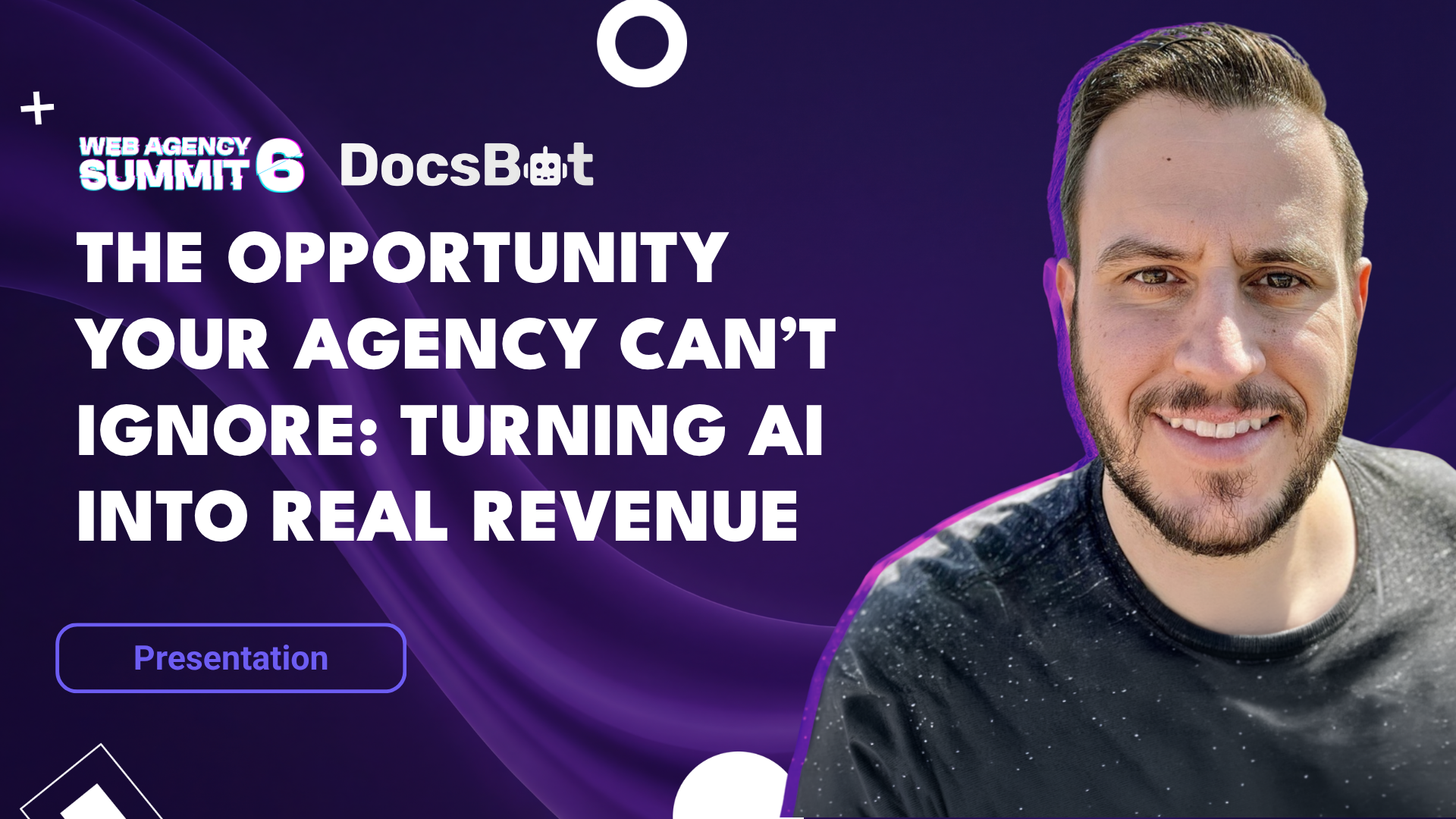
Aaron Edwards, a long-time technology builder for the agency world and co-founder of DocsBot AI, delivered a focused and practical talk on why digital agencies are sitting on a once-in-a-generation revenue opportunity with AI. His central argument is that agencies already own the most valuable asset in the AI adoption chain: trusted client relationships. Most agencies are watching from the sidelines, either through fear of getting things wrong, uncertainty about the technology, or unwillingness to invest in internal R&D. Aaron's message is that they do not need to. The real competitive advantage is not building AI systems from scratch, but implementing them intelligently for clients who cannot do it themselves.
The session draws on Aaron's twelve years as CTO of WPMU Dev, his real-world data from DocsBot AI (which has handled over six million support conversations with strong resolution rates), and broader industry signals including Y Combinator's investment
thesis and commentary from Mark Cuban. He frames the moment as a structural shift away from software-as-a-service toward what he calls "service as software," where the value lies not in selling a tool but in owning and delivering the outcome. Agencies that reposition around outcomes rather than deliverables, and that partner with AI platform providers rather than trying to build in-house, are best placed to win.
Key takeaways
- 01You are not behind. Nobody has fully figured out AI yet. In a market changing this fast, being one week ahead of your clients is enough to be the expert.
- 02Agencies own the most valuable asset in AI adoption: client relationships. Businesses do not need software. They need someone who understands their processes and can translate those into AI-powered solutions.
- 03The demand is real and unmet. Clients are actively seeking AI help and struggling to find agencies willing and able to deliver it. Execution is the gap.
- 04Sell outcomes, not AI. Clients do not want AI for its own sake. They want reduced support load, higher conversions, automated workflows, and fewer repetitive tasks. AI is the means, not the end.
- 05"Service as software" is the new model. Y Combinator and Mark Cuban both signal that the highest-value play is using software yourself and selling the finished outcome at a significant premium, not selling the software tool.
- 06AI agents are now genuinely production-ready. DocsBot's data shows 76% automatic resolution of support queries, 89% escalation prevention, and 97% customer satisfaction, demonstrating these tools work at scale in the real world.
- 07You do not have to build it yourself. Partnering with AI platform providers lets agencies deploy sophisticated solutions in days or weeks, not months, without maintaining an internal R&D function.
- 08New service lines are available right now. AI audits, automation retainers, AI agents for support and sales, AI employee packages, internal knowledge bots, bespoke integrations, and team education are all things clients will pay for today.
- 09The shift is from tools to teammates. AI agents are moving beyond answering questions to actually taking actions: resolving billing issues, triggering workflows, filling forms, and interacting with external systems autonomously.
- 10The agencies that win will be the first to implement, not the ones who understand AI most deeply. Speed of execution for clients is the competitive differentiator.
The Central Problem: Speed of Change
Aaron opened by asking the room a direct question: do you feel like you are moving fast enough with AI?
He has asked this of many business owners, agency owners, and conference attendees and reports that the answer is almost universally the same: no. Everyone feels like they are falling behind. This is not unique to small agencies. Even startups and billion-dollar companies, including those at the frontier of AI development, feel the same pressure.
For agency owners specifically, this creates a particular tension. Agencies are supposed to sell certainty. Clients hire agencies because they are the experts. When the foundational technology is shifting so rapidly that even experts are uncertain, it can feel like guesswork.
Aaron is explicit that this feeling is understandable but argues it is not quite the right frame. He breaks down the actual nature of the problem: Internal systems are changing. The tools, workflows, and platforms agencies rely on to deliver their work are all in flux.
Revenue models are shifting. What clients buy and how they expect to pay for it is evolving.
Client expectations are changing constantly. Each new capability unlocked by a new model or tool reshapes what clients think is possible and, by extension, what they expect.
A new AI model or tool is released almost every week. Each one opens up capabilities that did not exist the week before. The cadence of change is genuinely unprecedented.
Importantly, Aaron notes that AI is not yet eliminating most work. But when organisations try to implement it, it exposes pre-existing gaps: bad data produces bad AI outputs, undefined processes cannot be automated, and planning cycles that used to run for years now need to be revisited every few months.
Reassurance: Nobody Has Figured This Out
Aaron is direct in wanting to reassure his audience. He says flatly: you are not behind.
Nobody has this fully figured out. The entire industry, from scrappy startups to the largest technology companies in the world, is in the same position of running hard to keep up with a technology that is outpacing everyone's ability to fully plan for it.
His practical heuristic for agencies is memorable: you only need to be about one week ahead of your client to be the expert. That is how fast this market is moving. The bar for being the person in the room who knows more about AI implementation than the client is genuinely not that high, because the client almost certainly knows very little about it in practical terms.
This is meant to be liberating rather than alarming. It means agencies should not be paralysed waiting until they feel fully ready. That moment will not come. The window for action is now, and the threshold for being useful to clients is lower than most agencies assume.
The Core Opportunity: Agencies Already Own the Most Valuable Asset
Aaron's most strategically important point is this: if you have an agency and you have client relationships, you already own the most valuable component in AI adoption.
His reasoning is simple. Businesses do not actually need AI software. What they need is: Someone who understands their specific business processes.
Someone who can identify where AI can solve real problems within those processes.
Someone who can implement the right tools in the right way.
Someone they already trust to do that work on their behalf.
That last point is critical. Agencies have the trust. Large technology companies and AI startups do not have deep relationships with tens of millions of small and medium-sized businesses. Agencies do. The missing piece for those businesses is not a software licence. It is an expert who can come in, diagnose, and implement. That is exactly what an agency does.
Aaron references a personal example to illustrate the unmet demand. He has a close friend who is not technical, who has called five to ten different agencies and developers trying to get help with AI implementation for his business. He can barely get a callback from any of 1.
them, much less a quote. This is not an isolated case. The demand is there. The execution capacity is not.
Selling Outcomes, Not AI
One of the clearest and most actionable shifts Aaron advocates is a change in how agencies frame and sell their services. He argues that "AI" as a selling point has already been through a hype cycle where it became a buzzword, something that got placed in a strategy deck on whatever page seemed appropriate. That framing is not compelling to clients.
What clients actually want is specific and concrete: A reduced support load.
Higher conversion rates.
Automated workflows that free up their team.
The elimination of repetitive, low-value tasks from their operations.
AI is the means to achieve those outcomes. It is not the thing being sold. Agencies that reposition their offer around these concrete outcomes, and use AI as the implementation mechanism, will find it much easier to make the case to clients and, critically, to justify a premium price.
He draws a parallel to how agencies have historically sold. In the past, you sold a website.
You sold a marketing service. The next phase of agency work is selling an outcome. The technology stack underneath that outcome is largely irrelevant to the client, as long as the outcome is delivered.
The "Service as Software" Shift
Aaron spent time on a structural shift in the technology industry that has profound implications for agencies: the move from software as a service (SaaS) to what he calls service as software.
He has personal skin in this game. As a SaaS founder, he built his career around the SaaS model, which he acknowledges has historically been seen as the gold standard of business models. Low cost of goods, near-infinite scalability, no dependency on headcount to serve more customers. For many years, it was the model to emulate.
But he references Mark Cuban's observation that software is dead, because everything is moving toward customised, unique utilisation. The generic tool sold at scale is losing its value. What has value is the service built on top of the tool, the implementation, the configuration, the ongoing management, and the expertise.
This is where Y Combinator's framing becomes relevant. Aaron quotes from Y Combinator's most recent request for startups document, which functions as a public statement of what
kinds of companies they want to fund. One of the top priorities stated was essentially: instead of selling software to customers to help them do work, you can charge significantly more by using the software yourself and selling the finished outcome. The implication is that the highest-margin business is not selling the tool but delivering the result.
For agencies, this is a significant validation. Agencies have always been in the business of using tools to deliver outcomes. The difference now is that AI allows them to deliver those outcomes at a scale and speed that was previously impossible, and to do so in a way that looks more like a software business in its margin structure and scalability than a traditional service firm.
The Scale of the Market
Aaron contextualises the opportunity with some market sizing. There are more than 33 million small to medium-sized businesses in the United States alone, with many more globally. The overwhelming majority of these businesses cannot afford to hire in-house AI expertise. They are not OpenAI or Anthropic, who can offer million-dollar compensation packages to attract the best AI engineers in the world.
What they can afford is an agency that has built the expertise, maintains the relationships with the right platform providers, and can implement AI solutions in a cost-effective way.
This is precisely the market that agencies are positioned to serve, and it is enormous.
Mark Cuban has also spoken about what Aaron describes as a massive AI-driven wealth transfer happening right now. The core of this transfer is that the businesses that figure out how to implement AI effectively will capture significant value from those that do not, and the intermediaries who facilitate that implementation are well placed to capture value themselves.
DocsBot AI: Real-World Proof Points
Aaron grounds the session in real performance data from DocsBot AI to demonstrate that AI agents are not theoretical at this point. They are production-ready and delivering measurable results at scale.
In the last year alone, DocsBot has handled more than six million real customer support conversations. The outcomes: 76% of conversations were answered automatically and resolved without any human involvement.
89% escalation prevention rate, meaning that nearly nine out of ten interactions that would previously have required a human agent were fully resolved by the AI.
97% customer satisfaction across those interactions.
He walks through three primary use cases that DocsBot clients are deploying:
1. AI Support Automation Businesses train the AI agent on their documentation, help centre content, and historical support tickets that human agents have previously answered.
The agent can then answer customer questions in any language, immediately, around the clock, at a fraction of the cost of human support. The return on investment is rapid and measurable.
2. AI Sales Assistants Businesses deploy agents on their websites to answer product questions, qualify inbound leads, capture contact details, and in doing so increase conversion rates. The agent is available at the moment of highest purchase intent, which is when a prospective customer is browsing the site and has a question that would otherwise go unanswered until business hours.
3. Internal Knowledge Agents Larger organisations, particularly enterprises, have extensive repositories of SOPs, HR policies, business processes, and procedural documentation. Training an internal agent on this content and exposing it to the team allows employees to get accurate, instant answers to questions that would previously have required emailing HR, searching through wikis, or waiting for a manager. This saves teams measurable hours every week.
Why Agencies Are Sitting on the Sideline
Aaron acknowledges the hesitation he sees in the market and lists the reasons agencies give for not yet capitalising on this opportunity: Fear of getting it wrong. Taking on a new category of service with a client who is paying for it raises the stakes significantly. Getting it wrong could damage the relationship.
Lack of technical depth. Many agencies, particularly web design and marketing-focused ones, do not have engineers on staff who are comfortable working with AI systems.
Pace of change. The tools and platforms are changing so quickly that investing in learning one approach feels risky when it might be obsolete in six months.
Unwillingness to fund internal R&D. Keeping up with AI technology properly requires ongoing investment in experimentation and learning. Most agencies are not structured to do this.
The result is that most agencies are watching and waiting, still selling the same services they were selling two years ago, even as the market is shifting around them.
Aaron argues this is the wrong choice. Not because the concerns are invalid, but because the solution to all of them is the same: partner with providers who are already doing the R&D and keeping up with the technology. You do not need to build it. You need to implement it.
The Partnership Model: Don't Build, Implement
This is Aaron's strategic recommendation and arguably the most actionable part of the session. The agencies that win in the AI era are not going to be the ones that build everything from scratch. They are going to be the ones who partner with the right platform providers and focus their energy on implementation, client management, and the consultative work of understanding business problems.
DocsBot has a significant number of agency customers who are doing exactly this. They resell DocsBot's service, sometimes under their own white-label brand, sometimes not, typically as a management contract to their clients. What would have taken months of custom development to build can be deployed in days or weeks through this model, with DocsBot handling the underlying platform, the model updates, and the ongoing R&D.
This allows the agency to: Move quickly, delivering real value to clients fast.
Avoid the cost and risk of internal technology development.
Stay competitive as the underlying AI technology evolves, because the platform partner is absorbing that cost.
Focus on what agencies are actually good at: understanding businesses and delivering solutions.
The formula he describes is consistent with Y Combinator's insight: use the software platform, deliver the outcome to the client, and charge a premium for the expertise and execution.
New Service Lines Available Now
Aaron lists several categories of AI-related services that agencies can be selling today, many of which have no direct equivalent in the traditional agency service catalogue: AI Audits / Automation Audits A consulting engagement where the agency maps a client's current business processes, identifies where AI can add value, and produces a prioritised roadmap. This can be a standalone paid engagement or a gateway into implementation work.
AI Agents for Support and Sales Deploying conversational AI agents for customer-facing functions. This includes support automation, sales qualification, lead capture, and proactive engagement on websites and platforms.
AI Employees A more expansive framing where the deliverable is not a chatbot but a functional AI team member, capable of performing defined roles autonomously. This is increasingly viable with current agent capabilities.
AI Automation Retainers Recurring monthly contracts to manage, optimise, and expand AI implementations for clients. This is the high-value, predictable revenue model that mirrors the best aspects of traditional agency retainers but with higher margins.
AI Education and Training Even when clients have access to AI tools, they often lack the knowledge to use them effectively for their specific roles and workflows. Agencies can sell structured training programmes, either as standalone products or as part of implementation packages.
Bespoke AI Integrations With the current capabilities of AI-assisted coding, it is now possible for agencies to build custom integrations between AI agents and the specific platforms, databases, and APIs that a client uses. What previously would have required a dedicated software development team can now be achieved much more efficiently.
The Shift from Tools to Teammates
Aaron closes the content portion of his talk with a forward-looking observation about where AI agents are heading. He frames it as a shift from tools to teammates.
Phase one of AI in business was essentially a more sophisticated search engine. You asked a question, the AI answered it. This was immediately useful, particularly for support use cases, and it is where DocsBot started.
The current and emerging phase is fundamentally different. AI agents can now not only answer questions but take action: In customer support, instead of merely answering a billing question, an agent can actually interact with the billing system (Stripe, for example), resolve the issue, apply a credit, or process a refund.
In operations, instead of suggesting what should be done, an agent can actually execute the steps, triggering workflows, updating records, and interacting with multiple connected systems.
In product experiences, instead of answering a user's question about how to configure something, an agent can do the configuration for them, filling in forms, adjusting settings, and completing actions on behalf of the user.
Aaron notes that this is the direction DocsBot is actively developing toward. The week of this session, DocsBot was announcing what he calls "DocSpot week," a significant release of new features designed to shift the platform from what he describes as an "answer engine" to an "action engine." The agent becomes capable of performing actions on behalf of users and teams, which dramatically expands its usefulness and the range of problems it can solve.
The practical implication for agencies is that the services they can sell around AI agents will become significantly more valuable as agents become capable of doing more. Getting into
the market now, with current capabilities, positions agencies well to expand those services as the technology matures.
The Fundamentals Still Win
Aaron concludes by grounding the session in something consistent and reassuring: the fundamentals of running a good agency have not changed.
What makes an agency valuable has always been the same things: The ability to build trusted relationships with clients.
The ability to walk into a business, understand its processes and problems, and identify what it needs.
The ability to deliver solutions that genuinely meet those needs.
AI cannot replace any of those things. It can, however, dramatically amplify them. An agency that understands a client's business can now deploy AI to serve that client faster, at greater scale, and with higher margins than was ever previously possible. The consultative, human, relationship-driven elements of agency work are not being made redundant. They are being supercharged.
His final line summarises the argument cleanly: the agencies that win in this era will not be the ones that understand AI the best. They will be the ones who figure out how to implement it first for their clients.
Q&A: Training DocsBot for Agency Clients
During the brief Q&A, an attendee asked about how to train DocsBot when you have a wide variety of clients with different needs and are unsure what to feed the bot.
Aaron's answer was practical: Start with customer support and customer experience. This is the lowest-hanging fruit and the most immediately measurable in ROI. Train the agent on existing documentation and, critically, on past support tickets that human agents have already answered. This means you do not even need to write new documentation. The historical record of how your team has answered questions is itself training material.
From there, connect the agent to operational systems. Stripe for billing. The client's platform APIs for account management. This transforms the agent from something that answers questions into something that resolves issues end-to-end.
For internal use, he recommends building custom agents for teams that connect to all the services and software the team already uses, allowing the agent to perform tasks across those systems on behalf of team members.
 About the speaker
Aaron Edwards
Co-founder and CEO of DocsBot AI
About the speaker
Aaron Edwards
Co-founder and CEO of DocsBot AI
Aaron Edwards is co-founder and CEO of DocsBot AI, a platform that helps businesses build AI-powered support and sales agents. He works with agencies looking to package AI automation as a service for their clients.