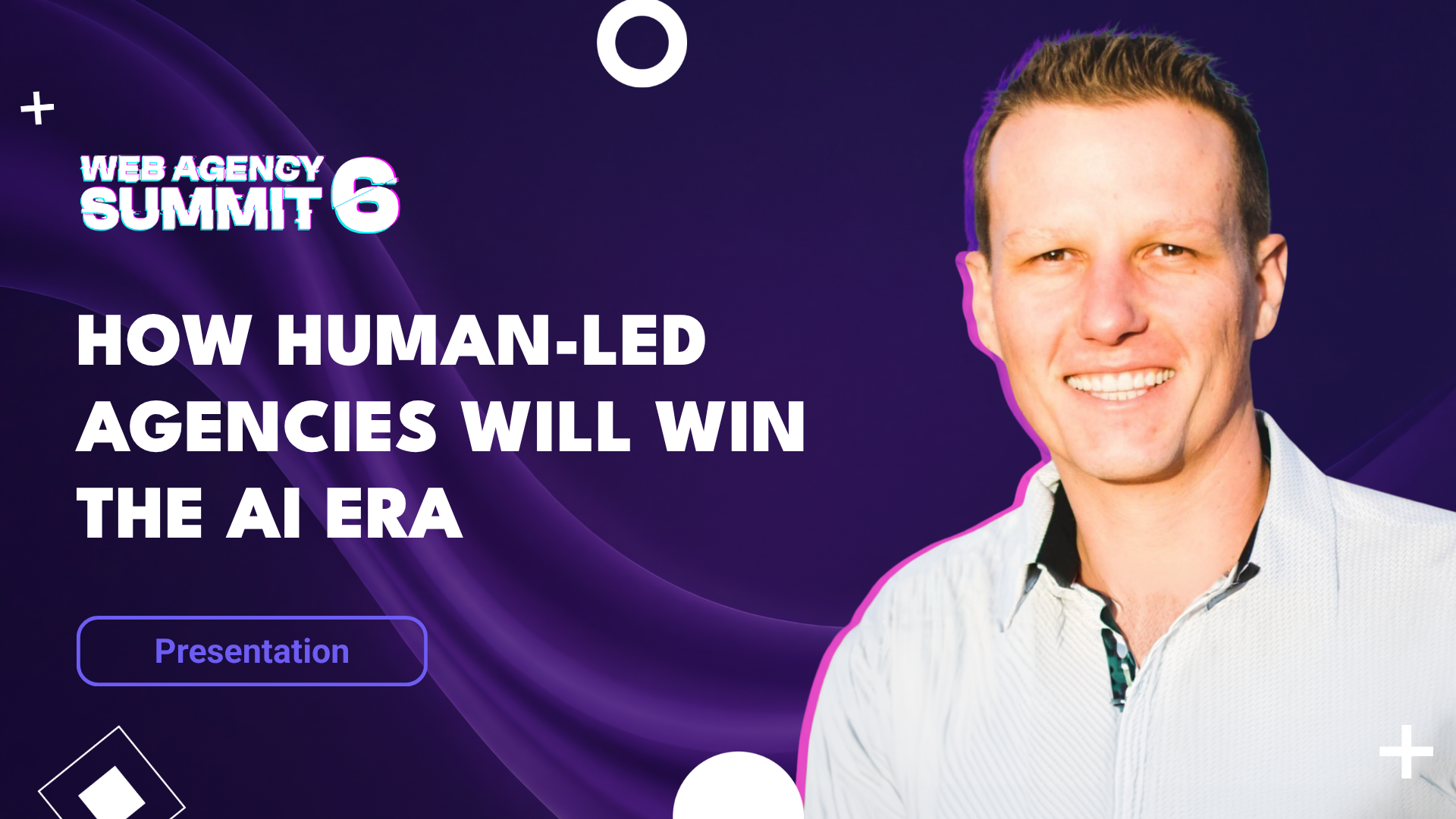
Kenn Kelly, CEO of the agency Never Settle, delivered a session centred on a straightforward but often overlooked argument: in the AI era, agencies will not be separated by which tools they use, but by how well they protect and deepen human connection. His talk covered two interrelated themes. The first is culture as a deliberate, systems-driven outcome rather than a set of aspirational values stuck to a wall. The second is a principled framework for deciding where AI should and should not operate within an agency. Kelly drew on his own experience leading a remote, globally distributed team to illustrate both the failures and the successes of intentional people investment. His core message is that the agencies that will become impossible to replace are those that operationalise AI precisely where it creates leverage while fiercely protecting the human relationships and trust that no tool can replicate.
Key takeaways
- 01Culture is not a poster or a set of values statements. It is the exact output of whatever your systems consistently produce.
- 02Nothing drifts itself into good. Without intentional, consistent investment, everything in a business atrophies.
- 03A thriving, connected culture is a hard business asset that directly affects retention, referrals, trust, and team health.
- 04AI must never write final drafts of anything going to another human. It is good at first drafts, brainstorming, and data processing, but its tone creates a gap that undermines genuine human connection.
- 05You should have explicit playbooks not just on how to use AI but on where not to use it, covering high-trust communication, nuanced strategy, brand voice, leadership conversations, and belonging-building interactions.
- 06Standardising AI in an agency requires agility. Models move too fast for a set-and-forget policy, even over six months.
- 07The right approach to AI adoption is to pick one lane, go deep, master it, then expand. Trying to adopt AI everywhere at once yields no meaningful return.
- 08Protecting people from overwork (enforcing 40-hour week limits, no after-hours interruptions, 90 minutes of distraction-free deep work each morning) is a system, not a perk, and it directly serves the business.
- 09The future of agencies is not people versus AI. It is exceptional people equipped with better systems, sharper judgment, and stronger leverage, doing what they are most gifted at.
Introduction and Context
The session opened with a brief technical delay, after which host Stephanie introduced Kenn Kelly as the CEO of Never Settle. Due to the time constraints caused by the delay, there was no extended pre-session banter and Kelly moved directly into his content. He acknowledged the event warmly, noting it was his second year participating and that he finds significant value in learning from the broader agency community gathered there.
Kelly framed his session around two parallel ideas that he would develop throughout: the Never Settle Operating System (a set of intentional cultural systems his agency has built), and the Connection Advantage (the argument that human connection, not technical capability, is the decisive competitive differentiator for agencies in the AI era).
The Core Premise: Out-Connecting, Not Out-Teching
Kelly opened with his central argument stated plainly: "The agencies that win won't be the ones that are out-teching the competition. They're going to be the ones that are out-connecting it."
He grounded this in a recognition that everything in business ultimately involves people.
Agencies sell goods and services to people, not to machines. The team members delivering the work are people. The clients receiving it are people. In Kelly's framing, losing sight of this fundamental truth is the root cause of most agency cultural decline. As AI accelerates and the pace of industry change reaches a level we have never previously experienced, the one stable constant remains people and their capacity for genuine relationship.
He was direct about the competitive threat: AI tools now allow someone with no accumulated expertise to acquire skills that previously required 10,000 or 20,000 hours of practice. A person can enter a market and compete with an established brand designer, programmer, or strategist without having put in that foundational work. This dramatically lowers the barrier to competition in service markets. The implication for agencies is stark: if your competitive moat is purely technical capability, it is eroding faster than it ever has before.
Nothing Drifts Into Good: The Philosophy of Intentional Investment
Before diving into specific systems, Kelly introduced what he described as a universal principle, shared with him by a mentor named Randy Roman. The insight is simple: nothing drifts itself into good.
Kelly used his cooling cup of coffee as an illustration. Left alone, heat dissipates. The coffee gets cold. The same principle operates across every domain of a business. Relationships, culture, systems, team capability, client trust — all of it atrophies without consistent, intentional investment. The implication is that if your culture feels like it is just "happening," it is almost certainly drifting in a direction you would not choose.
This framing set up everything that followed. Every system, every practice, every constraint Kelly described in the Never Settle Operating System exists because someone made a deliberate choice to invest in it rather than allow drift to take over.
Culture as an Outcome of Systems, Not Wishful Thinking
The Problem with Vague Culture Talk Kelly was candid that most discussion about culture in the business world is too vague to be actionable. He acknowledged the common business principle that "culture leaks" and "vision leaks," noting these ideas are true but do not give leaders anything concrete to hold onto.
They describe a problem without offering a mechanism for solving it.
His reframing is direct: culture is not what you put on the wall. It is what your systems keep producing. The culture of your agency is a precise reflection of what you consistently invest your time, energy, money, and presence into. No more, no less.
Culture as a Hard Business Asset A key rhetorical move in Kelly's talk is insisting that a thriving, connected culture is not a soft or intangible thing. It is a hard business asset with measurable impacts on retention, referrals, trust with clients, and the overall health of the team. Leaders who dismiss culture investment as "soft" are misclassifying what is actually a core driver of business performance.
Honest About His Own Record Kelly was notably candid about the fact that Never Settle has not always lived up to its own systems. He made clear he was not presenting from a position of having everything figured out. He described seasons where their culture has been thriving and seasons where it has atrophied because investment lagged. He positioned his insights as learnings drawn from decades of noticing what works, what does not, and what the downstream consequences are in each direction.
The Gardening Analogies Kelly used two gardening analogies to illustrate the gap between expectation and action.
First: a leader who wants meaningful relationships with their team but does not create intentional space for those relationships to develop is like a farmer hoping for shade but never having planted a tree. Second: a leader who wants their team to thrive inside and outside of work but does not attach any real metrics or investment to that aspiration is like a gardener who wants flowers but has never watered the soil. Both images make the same point. Hope is not a system.
The Never Settle Operating System: Specific Practices and Systems
Mission: Connection Built In From the Start Kelly described Never Settle's mission as "to create cultures of discipleship through business and innovation." This is not incidental to the way the business runs. It is a direct mandate for the leadership team to mentor, invest in, and disciple their people as part of how they succeed as a business. Connection is not an optional add-on to the mission; it is embedded in it.
Management Is Personally Mentored Every member of the Never Settle management team is personally mentored and invested in at a human level. Kelly described this as involving no forced separation between personal and professional life. There is no requirement for team members to share their private
circumstances, but the environment creates space for it, and Kelly finds that when people are given the room to discuss what is happening at home, it is "extremely life-giving." It allows them to process difficulty and move through it, rather than suppressing it and having it leak into their work.
Kelly pushed back on the assumption that people can fully compartmentalise. If things are stressful at work, that follows people home. If someone is dealing with a health crisis, a marriage struggle, or, as he noted, the reality of working with team members in war-torn countries, that does not disappear the moment they open their laptop. Creating space to acknowledge the human context allows people to be genuinely present at work.
Core Values as Virtues, Not Metrics Never Settle's core values are framed as virtues rather than as performance metrics. Kelly gave stewardship as one example. These are ways of being, not just business behaviours.
Critically, these virtues are integrated into annual performance reviews. Team members are evaluated on how well they exemplify each virtue in practice, not just whether they hit targets.
Enforced 40-Hour Work Week Limits Never Settle enforces a cap on how much its team members work. The limit is 40 hours per week, calculated as an average across a rolling two-to-three-week window. This gives flexibility for agency-specific peaks (a major site launch, for example) without allowing sustained overwork. If someone works 50 hours one week, they are expected to work 30 the next. The goal across any given year is that no one averages more than 40 hours per week.
Kelly was explicit that this is not a perk but a system designed to protect the capacity of the people on whom the business depends. Grinding people down does not produce better outcomes; it reduces the quality of thinking, creativity, and care that makes agency work valuable.
Generous Vacation and Full Disconnection Kelly described a policy of generous vacation entitlements and, more importantly, a genuine expectation that team members are not interrupted when they are away from work. This means no checking email, no checking Slack, no checking project management tools during personal time. The rationale is the same as the 40-hour limit: people who are genuinely rested are more present and more capable when they return.
No Inputs at the Start of the Day One of the more specific practices Kelly described is what he called "no inputs first thing."
The premise is neurological: once your subconscious encounters a notification, an email, or a news article, it cannot stop processing it. The mental space needed for deep, creative work is taken before the day has begun.
Never Settle encourages team members to avoid all notifications, email, and news when they first wake up. They are encouraged to be present with family, exercise, or do whatever matters most to them personally before the workday begins. Then, when they sit down to work, they do 90 minutes of uninterrupted deep work before looking at any messages or communications.
Kelly noted that this practice has faced resistance, particularly from salespeople and others in roles that feel they must always be available. His response is that no one is available 24 hours a day regardless — if you are asleep, clients and colleagues already experience a delay. The question is simply whether you are intentional about when that delay occurs.
Choosing to do your best thinking when your brain is freshest is the intentional version of a delay that happens either way.
Asynchronous Communication Stays Asynchronous As a remote company with team members distributed across multiple time zones (including some four or more hours ahead of others), Never Settle operates primarily on asynchronous communication. Kelly described a principle of not blurring the boundary between asynchronous and synchronous modes. If something needs a live conversation, it becomes live. But if it is asynchronous by nature, it should be allowed to remain asynchronous without the implicit pressure to respond immediately.
The expectation that a colleague four hours ahead should be online and responsive at the same time as someone in a different time zone is, in Kelly's framing, simply unreasonable.
Building a culture that respects time zone reality and treats async communication as a legitimate mode of working rather than a deficiency is part of how the team is able to remain globally distributed without burning out.
In-Person Gatherings and Quarterly All-Hands Despite operating remotely, Never Settle invests in bringing people together in person where possible, aiming for annual gatherings and quarterly all-hands dinners. These moments of physical co-presence are a direct investment in the human connection that asynchronous work cannot fully replicate.
Choosing to do your best thinking when your brain is freshest is the intentional version of a delay that happens either way.
Positioning the Agency for an Industry Storm
Kelly described the current moment in the agency industry not as a disruption but as a storm, noting that the word disruption undersells what is actually happening. He
acknowledged that storms do not have to be purely destructive — they can bring renewal — but that the scale and pace of change requires active navigation rather than passive hope.
The key competitive threat he returned to is the compression of skill acquisition timelines.
Services that once required years of accumulated expertise can now be approximated by someone using AI tools with no such background. This is not hypothetical; it is happening, and it is accelerating.
His response to this threat is the bison analogy. Bison are the only animals that, when they see a storm approaching, turn and run toward it rather than away from it. The theorised reasons are instructive: running into a storm is the fastest way through it, and storms tend to tear up the ground and leave fresh resources in their wake. The parallel for agencies is running into the AI era with curiosity and strategic intention rather than taking cover and hoping it passes.
Kelly connected this to a broader investment principle. Just as some investors see a market crash as an opportunity to enter, some agencies will see the current AI moment as an opportunity to go deep on what will give them sustained competitive advantage for the long haul rather than just chasing the next interesting tool.
Where AI Should Not Be Used: Protecting Human Connection
The More Important Question Kelly argued that while most agencies are asking what AI can do for them, the more strategically important question is what AI should not be doing. The tendency is to adopt and integrate broadly and quickly. The discipline is knowing where to stop.
His core principle: agencies should operationalise AI anywhere it creates leverage, but always protect the human connection. The agencies that over-automate relationships will become forgettable because automation is repeatable by anyone. The agencies that deepen human trust while using AI precisely and purposefully will become impossible to replace.
Things AI Should Never Handle Kelly listed specific categories he would never hand to AI: High-trust communication: Anywhere trust is being built or maintained, AI should not be the voice. Human discernment and presence are irreplaceable in these interactions.
Nuanced strategy and judgment calls: Where there is significant ambiguity and the stakes are high, AI's pattern-matching is no substitute for human judgment shaped by context, experience, and relationship.
Brand voice: AI can assist with drafts and ideation, but if it is writing the final version of anything that carries the agency's voice, that voice can be copied by anyone. It loses its distinctiveness. More critically, the final review must always be human.
Leadership conversations: Particularly any conversation involving feedback in high-tension situations, team conflict, or anything where belonging is at stake.
Belonging-building interactions: Culture is built through repeated moments of human connection. Outsourcing those moments to AI undermines the very thing that makes a culture coherent.
The Final Draft Rule Kelly was pointed about one specific practice he sees as a significant risk: using AI to write final drafts of anything that will be sent to another human. He is not opposed to using AI for brainstorming, first drafts, research, and distillation. But AI's tone — its perfectionism, its fondness for business jargon and verbose phrasing — creates a gap between the writing and the reader that undermines connection.
He offered a practical test: when you review a final draft, are you doing more than just replacing the em-dashes? If the substance is still AI-shaped, the human connection is missing. He encouraged agencies to strip out "overly verbose business jargon" and remember that clients do not care how smart you sound. They care whether you understand their problem and can actually solve it.
Emotion Drives Decision-Making Kelly grounded this argument in a brief reference to research on emotional decision-making.
He cited the work of Albert Mehrabian (which he acknowledged is frequently misread in popular culture) and clarified that what Mehrabian's research actually demonstrates is that removing emotion and trust from a decision does not make people more rational. It makes them worse at deciding. The implication for agencies is direct: if your communication strips out the human element in favour of optimised, AI-generated professionalism, you are not helping clients make better decisions. You are undermining the trust that makes decisions possible.
He reinforced this with an observation about high-stakes clients: the larger the client, the more important the work, the more critical it is that the human voice, the real voice, is present in every significant communication.
You are undermining the trust that makes decisions possible.
Where AI Should Be Used: Creating Leverage
Kelly balanced his constraints on AI use with a clear affirmation of where it creates genuine value. His list included: Prototyping (code, designs, concepts)
First drafts of written material Large-scale data compilation and conversion into reports Converting images into usable files Brainstorming and ideation Co-coding and debugging Building custom internal systems and processes at a fraction of their previous cost Workflow automations and repetitive operational tasks He made the point that tools that were previously expensive and time-consuming to build custom — systems tailored precisely to a specific agency's workflow — can now be built at roughly one-twelfth the cost in a fraction of the time. This is genuine leverage, and agencies should pursue it.
The broader principle he was pointing toward: AI used where it creates operational efficiency and scale frees people to do the things that actually require them to be human.
The goal is not less human work. It is higher-quality human work.
Standardising AI Use: Three Principles for Staying Agile
Kelly argued that standardising AI in an agency is a fundamentally different challenge from standardising a traditional SOP or playbook. The models are moving too fast for a set-and-forget approach. He described seeing meaningful shifts in what models can do on a weekly basis. A standard written today may need revision within six months, and possibly much sooner.
He offered three principles for navigating this: 1. Play and Test — You Have to Actually Use It There is no substitute for hands-on use. Watching YouTube tutorials or completing courses about AI is not the same as using it daily on real problems. Kelly's framing here was that all learning is ultimately self-learning: knowledge only becomes internalised when you apply it yourself and discover where it works and where it does not. This means team members need to actively use AI tools in their own roles, not just be briefed on them.
He also noted that AI skill atrophies quickly. It is not a topic you can study once and return to. Like any genuinely useful skill, it requires consistent practice or it degrades.
2. Pick a Lane and Go Deep AI is integrated into too many tools and applicable to too many processes for any agency to become proficient at everything simultaneously. Kelly's advice is to choose one specific area — communications, software development, data processing, design — and go deep on mastering AI's application in that lane before expanding.
He used a building analogy: if you want to build high, go deep first. Master one application thoroughly. Understand its limitations and its real leverage points. Operationalise it in a way that creates measurable value for a specific part of the business. Then, once that is solid, extend to the next area.
The alternative — trying to adopt AI everywhere at once — yields superficial engagement with many things and genuine mastery of none.
3. Stay Adaptive and Keep the Standard Evolving Once a standard is established, the obligation is to keep updating it as the tools evolve. This means regularly reviewing whether the current standard still reflects what the tools can do, documenting any changes in a way the whole team can access, and ensuring that the entire team is operating from the same current understanding.
Kelly used the image of a rowing crew: a team rowing in sync at a moderate pace will outperform a team where some members are rowing harder and faster but out of sync with each other. The agency that wins is not the one with the most powerful individual AI users, but the one where every person understands the same standard and is applying it in the same direction.
Conclusion: Where Humanity Must Begin
Kelly closed by summarising the distinction that he believes will define agency winners in the AI era. The winning question is not how much AI can be used, but where AI must stop and where humanity must begin.
The future of work, in his framing, is not people versus AI. It is exceptional people, equipped with better systems, sharper judgment, and stronger leverage, doing the things they are most gifted at. Agencies that over-automate their relationships will become forgettable.
Agencies that use AI precisely and strategically while deepening human connection and trust will become impossible to replace.
He closed with a four-part call to action: build your systems, protect your connection, make your culture measurable, and live a bigger story.
Kelly directed anyone who wanted to connect or access resources to his website at neversettle.it and noted that he is reachable on social media at his name, Kenn Kelly.
 About the speaker
Kenn Kelly
CEO of Never Settle
About the speaker
Kenn Kelly
CEO of Never Settle
Kenn Kelly is CEO of Never Settle, an agency growth consultancy. He has spent years advising agency owners on building human-led, relationship-driven businesses that can compete against automation.