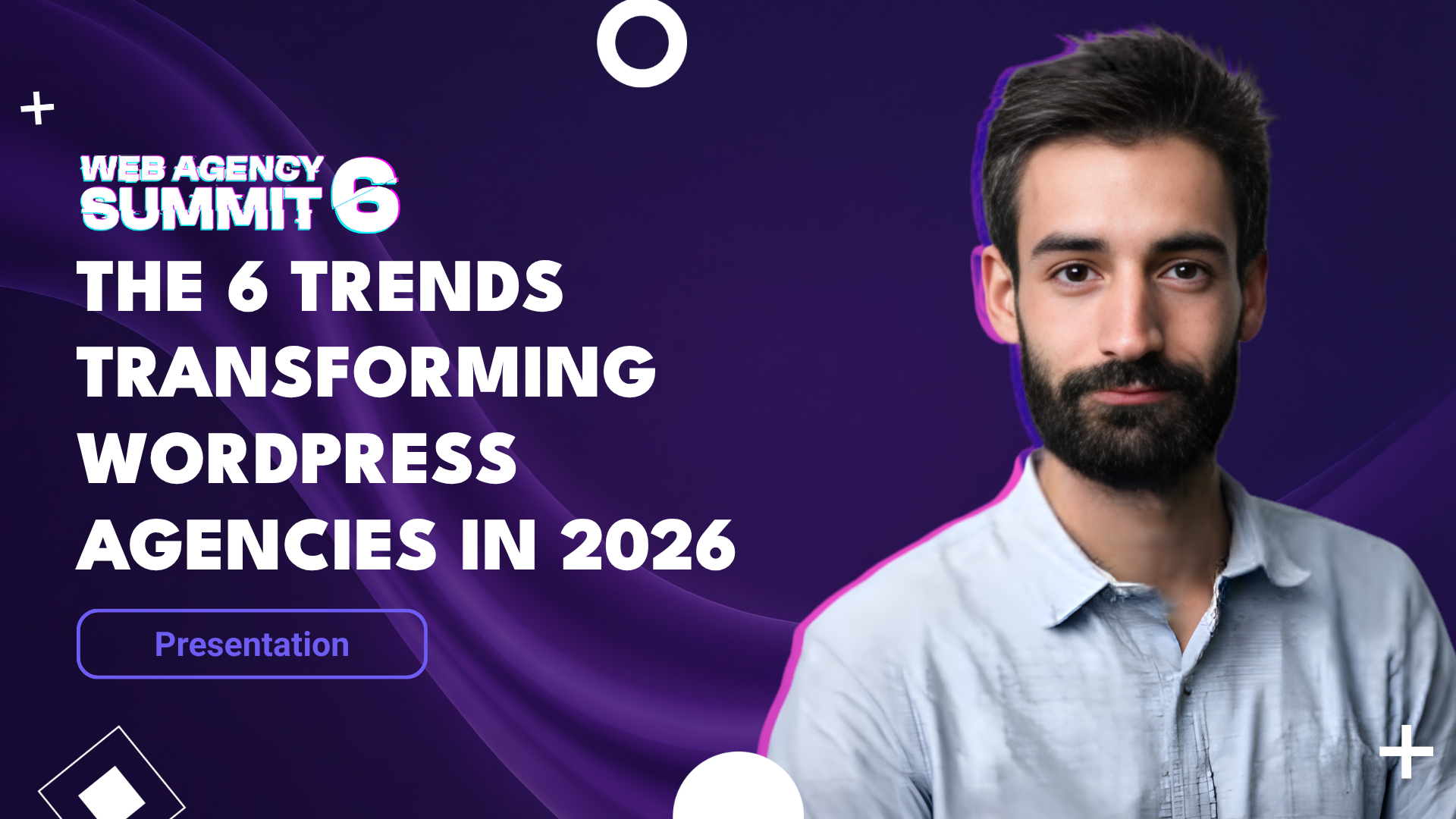
Aurelio Volle, co-founder of the WordPress website maintenance platform WP Umbrella, delivered a rapid-fire session framed around six trends reshaping how WordPress agencies operate in 2026. The central thread running through all six trends is the impact of AI — not as an existential threat to agencies, but as a force that changes the economics of production and, in doing so, forces agencies to reposition toward higher- value, advisory-led services.
Volle's argument is straightforward: AI lowers the cost and time required to produce websites and code, which means production alone is no longer a defensible business.
Agencies that survive and grow in 2026 and beyond will be those that shift their value proposition from "we build things" to "we advise, manage, secure, and own your digital presence." This repositioning has implications for how agencies price, how they acquire clients, how they automate their own operations, and how seriously they take security.
The session also includes a brief but notable post-presentation dialogue with host Andrew, covering WP Umbrella's build-in-public philosophy and how transparency about revenue and mistakes has become a competitive differentiator rather than a liability.
Key takeaways
- 01The cost of producing websites and code is falling rapidly, which forces agencies to shift their value from production to advice and strategic guidance.
- 02Care plans must evolve beyond plugin updates to encompass content creation, performance optimisation, security, and full digital partnership.
- 03Building authority through free, genuinely high-value content is becoming the primary client acquisition channel outside of word of mouth.
- 04Word of mouth alone is increasingly a growth bottleneck; agencies need to own topics and demonstrate expertise publicly to attract new clients.
- 05Niching remains a strong strategy, but it must be paired with a broader positioning as a "digital partner" or "digital gatekeeper" who helps clients navigate a confusing, AI-saturated landscape.
- 06Automation of repetitive, low-mental-value tasks is essential — not just for efficiency but to free up human capacity for high-value advisory work.
- 07Security is an urgent and growing revenue opportunity: the average time for a non-patched WordPress vulnerability to be exploited is 17 minutes, and the volume of vibe-coded, insecure websites is set to create a wave of maintenance and remediation demand.
- 08Recurring revenue through comprehensive care plans is the structural hedge against an unpredictable production market.
- 09Building in public — sharing revenue, churn, mistakes, and progress openly — builds trust with potential customers and forces continuous product improvement.
Trend 1: AI Is a Tool, Not a Replacement — Shift from Production to Advice
The Overheated AI Narrative Volle opens by acknowledging the noise around AI in the WordPress and broader tech world — the "vibe coding" hype, the claims that Claude (and AI more broadly) will kill designers, developers, SaaS businesses, and just about everyone else. His position is direct: "Claude is not going to kill anything, to be honest."
He argues that everyone needs to "breathe a little bit." The panic around AI displacement misunderstands what AI actually does and, more importantly, what it cannot do.
What AI Actually Does Well AI is, in Volle's framing, "a fantastic tool that allows you to produce much faster." It accelerates wireframing, code shipping, and SEO auditing. This is genuinely valuable and he does not dismiss it. But the speed gains are only meaningful if the person using the tool knows what they want and where they are going.
The Missing Ingredient: Context This is the crux of Trend 1. Volle argues that prompt engineering and the mechanical skill of using AI tools are not particularly hard to acquire — most people can pick them up quickly.
What is hard, and what has always been hard, is context: understanding what a client actually needs, what outcome they are trying to achieve, and how to translate that into something real and functional.
He states it plainly: "If you are using LLM and if you don't know where you are going, or if you approximately know where you are going, you will land in the wrong direction."
Agencies and experienced practitioners hold the context. This is where their irreplaceable value lives, and he believes this should give practitioners "some peace of mind."
The Two Strategic Choices Facing Agencies Given that AI is lowering production costs, Volle presents two paths: Option 1: Ignore the trend or deliberately focus on very high-ticket clients who may avoid AI for data privacy reasons or because of the complexity of their projects. He acknowledges this is viable for some, but notes these clients are rare and not representative of most agencies' typical clientele.
Option 2: Embrace the trend. Instead of competing with AI, serve the people who are using it — and come to the rescue of everyone who has vibe-coded something so poorly built that it will inevitably need professional maintenance.
Volle's recommended path is clearly Option 2. His argument rests on a straightforward observation: "Everything that is being produced in IT, whether it's WordPress, your smartphone, or any piece of vibe-coded websites, it needs to be maintained."
Reframing the Care Plan This leads directly into Volle's call for agencies to shift from production-led to advice-led business models. He argues that the line between successful agencies and those that struggle in the coming months will be exactly this transition.
Care plans, historically, were largely about updating plugins — low value, easily automated.
Volle says that era is over. Instead, agencies must expand care plans to include: Content creation Performance optimisation Security maintenance Full WordPress maintenance Strategic execution and planning The goal is to become "the owner of the online life of your clients." This expands the scope of the agency relationship from project-based to ongoing, embedded, and advisory — and it creates the recurring revenue that makes an agency resilient and future-proof.
Trend 2: Build Authority and Trust Through Free, High-Value Content
Why Authority Matters More Now Volle frames this trend partly as a response to the democratisation of production. If AI means that anyone can fake competence — generating code, designs, and content that looks professional — then the signal of genuine expertise becomes harder to read. Trust and demonstrable authority become the critical differentiators.
The Word of Mouth Bottleneck He references "recent studies" (not cited specifically) showing that word of mouth is becoming a growth bottleneck for many agencies. It remains the most obvious and effective acquisition channel, but relying on it exclusively caps growth. To attract clients beyond an existing referral network, agencies need to be visible and credible to people who do not already know them.
Owning Topics The solution Volle proposes is content-led authority building. Agencies need to "start owning topics" — to become the go-to resource for the specific problems their ideal clients face. The logic is that potential clients are often attempting to solve their problems themselves, using AI or other tools, and not fully succeeding. An agency that has clearly, publicly demonstrated it understands and can solve those problems is positioned to step in at exactly the right moment.
The High-Value Content Imperative Volle is emphatic that the word "high-value" is not a throwaway phrase here. He explicitly warns against producing "AI average trash content... full of n-dash" (his colloquial term for generic, formulaic AI output). He argues that AI-generated filler content is now so widespread that it creates its own form of fatigue — audiences are developing a sharp instinct for low-effort content and dismissing it immediately.
The content agencies produce must be genuinely useful, showing real knowledge of real client problems. This is harder to produce but far more effective.
Trend 3: Automate Everything You Can
The Battle of Productivity Volle states that the competitive environment for agencies is no longer purely a battle of talent. It is also, increasingly, a battle of productivity — specifically, how much genuinely valuable work an agency can produce per day. With AI lowering production costs across the board, the agency that wins is often the one that has freed up the most human capacity for high-value tasks.
What to Automate His guidance is practical: automate the things that carry a high mental cost and the things you are not good at. He gives security as a specific example — if security management is not a strength, use a platform that handles it for you, freeing your attention for areas where you add more value.
For WordPress agencies specifically, Volle recommends using a WordPress management platform — citing WP Umbrella and ManageWP as examples — to automate as many routine tasks as possible. Updates, monitoring, backups, security scanning: all of this can and should run in the background without demanding ongoing manual attention.
The Strategic Logic The underlying point is that automation is not just about efficiency for its own sake. It is about redirecting human attention toward the advice, strategy, and relationship work that AI cannot replicate and that clients are increasingly willing to pay a premium for.
Trend 4: Become a Digital Partner, Not Just a Builder
A Clarification on Niching Volle is careful to head off a potential misreading of this trend. The call to become a "digital partner" is not an argument against niching. He states clearly: "It's always an excellent idea to niche yourself in a market where you can have peer-to-peer recommendations." Niching improves legitimacy, referability, and the precision of value delivery. Agencies should absolutely niche.
The Problem: Digital Overwhelm The issue this trend addresses is something distinct from production. Clients — businesses of all sizes — are being bombarded. Automated outreach, AI-generated sales pitches, unsolicited campaigns, tool recommendations: the volume of noise directed at business owners has become overwhelming. Volle describes clients "getting bats" (bombarded) with messages "every day offering advice, campaigns, new leads, and so on."
This creates a specific kind of fatigue — not just AI fatigue, but digital decision fatigue.
Clients do not know who to trust or what to prioritise.
The Agency as Digital Gatekeeper The opportunity this creates for agencies is significant. An agency that has built genuine trust (Trend 2) and has positioned itself as an expert advisor (rather than just a builder) can step into the role of "digital gatekeeper" for its clients. It becomes the filter through which clients evaluate new tools, strategies, and investments.
Volle contrasts this with the old agency model: clients arrive with a project, the agency bids a number of days, builds the site, sells a minimal maintenance retainer (perhaps two hours per month), and the cycle resets. He argues this model is becoming obsolete.
The new model is about selling outcomes and owning how clients navigate their problems — including the meta-problem of simply keeping up with a fast-moving digital landscape.
Agencies that can offer this kind of ongoing strategic navigation will be more valuable and more sticky than those offering transactional production.
Trend 5: Security Is the Next Major Revenue Wave
The Vulnerability Window Volle cites a striking data point from PatchStack, a security partner of WP Umbrella: the average time for a non-patched vulnerability on a WordPress site to be exploited is 17 minutes. This figure underscores how automated and fast-moving the threat landscape is.
He connects this directly to the vibe coding trend. A large volume of websites is now being produced quickly, often by non-developers using AI tools, and the resulting code is likely to contain security flaws. These sites will be online, potentially handling real business data, and they will be targets.
WordPress Will Look Safer in Retrospect Volle makes a bold prediction: "In a few months from now, and you can quote me on this, we will all realise how safe WordPress actually was and is." His argument is that WordPress has historically been criticised as insecure largely because of its ubiquity — it is the most widely installed platform and therefore the most frequently targeted. But compared to the wave of hastily vibe-coded, non-standard, poorly maintained sites being produced now, WordPress's mature ecosystem of security tooling, regular updates, and large support community will look like a strength.
Security as a revenue opportunity: for agencies, this creates a clear opportunity. Maintaining what has been built, including auditing and securing vibe-coded sites that clients bring in, will open new revenue streams. Volle advises agencies to:
- Ensure they have mechanisms in place to keep client websites secure on an ongoing basis.
- Invest time, resources, and training in security.
- Use what he calls "infrastructure-based tools," established platforms with a high number of active installs and a proven track record, rather than new or unproven tools.
- Work with reputable hosting providers that take security seriously.
The trust loop: he closes this trend by tying it back to the session's central theme of trust. To thrive in the age of AI, you need trust; to maintain trust, you must ensure that what you build and maintain is secure. As LLMs improve, the attack surface of poorly constructed sites grows. The agency that takes security seriously closes this loop and reinforces the trust relationship with its clients.
Trend 6: Use AI to Amplify Your Existing Expertise
AI as an Enabler, Not a Substitute The final trend is a principle rather than a tactical instruction. Volle argues that the best outcomes from AI come when practitioners use it to amplify capabilities they already have.
The question to ask is not "what can AI do?" but rather "how can my expertise be amplified by AI?"
If you are strong in a particular area — say, WordPress performance optimisation — AI can help you produce audits faster, document recommendations more clearly, and scale your delivery without proportionally scaling your time. The value you add through your expertise is compounded.
The Danger of Misapplication On the flip side, using AI in areas where you lack foundational knowledge or skill creates problems rather than solving them. You are more likely to accept incorrect outputs, miss errors, and deliver substandard work. Volle notes that this leads to more mistakes, not fewer.
He does offer a nuance here: AI can also be used as a learning tool to build expertise in areas you are weak in. Used deliberately in a learning context, it can raise your baseline competence. But this is different from using AI to perform work you do not yet understand.
You are more likely to accept incorrect outputs, miss errors, and deliver substandard work.
Post-Presentation Dialogue: Building in Public
The Host's Question After the main presentation, host Andrew turns the conversation to WP Umbrella's distinctive approach of building in public — openly sharing revenue figures, churn rates, mistakes, and milestones. Andrew asks what gave Volle the confidence to operate with that level of transparency, particularly given that sharing revenue data could attract competitors.
Volle's Answer Volle's response is notably relaxed and philosophical. He turns the question back: "What's wrong in this kind of little transparency?" His view is that transparency about metrics like revenue and churn is simply not as dangerous as people assume.
He acknowledges the obvious risk: competitors can see your numbers and target you. But his response is "so what?" — it simply forces WP Umbrella to build a better product. He
frames market competition driven by transparency as a net positive for the entire ecosystem, pushing all players toward better solutions.
He also cites a telling cautionary tale from the other direction: ManageWP, once a well-regarded and widely-used competitor with a large active install base, was acquired by GoDaddy and subsequently became what Volle calls a "black box." No more changelog updates, no public communication. He and his co-founder decided deliberately not to make that mistake. Transparency became part of their identity and, he believes, a meaningful reason why customers choose WP Umbrella.
He concludes simply: "People love to see the story."
Andrew's Response Andrew validates the approach enthusiastically, noting the growth of WP Umbrella and praising the transparency practice. He also segues briefly into the security theme, reinforcing Volle's point about the 17-minute vulnerability window and the importance of protecting clients from malicious actors. He notes WP Umbrella's partnership with PatchStack and endorses it as a smart structural choice.
Andrew closes by contextualising Volle's contribution in the day's broader programme, noting that another speaker (Nicole) will address LinkedIn as a trust-building tool — and pointing out that Volle's emphasis on trust in this session directly prefigures that theme.
 About the speaker
Aurelio Volle
Co-founder, WP Umbrella
About the speaker
Aurelio Volle
Co-founder, WP Umbrella
Aurelio Volle is co-founder of WP Umbrella, a WordPress site management and monitoring platform used by agencies managing client sites at scale.