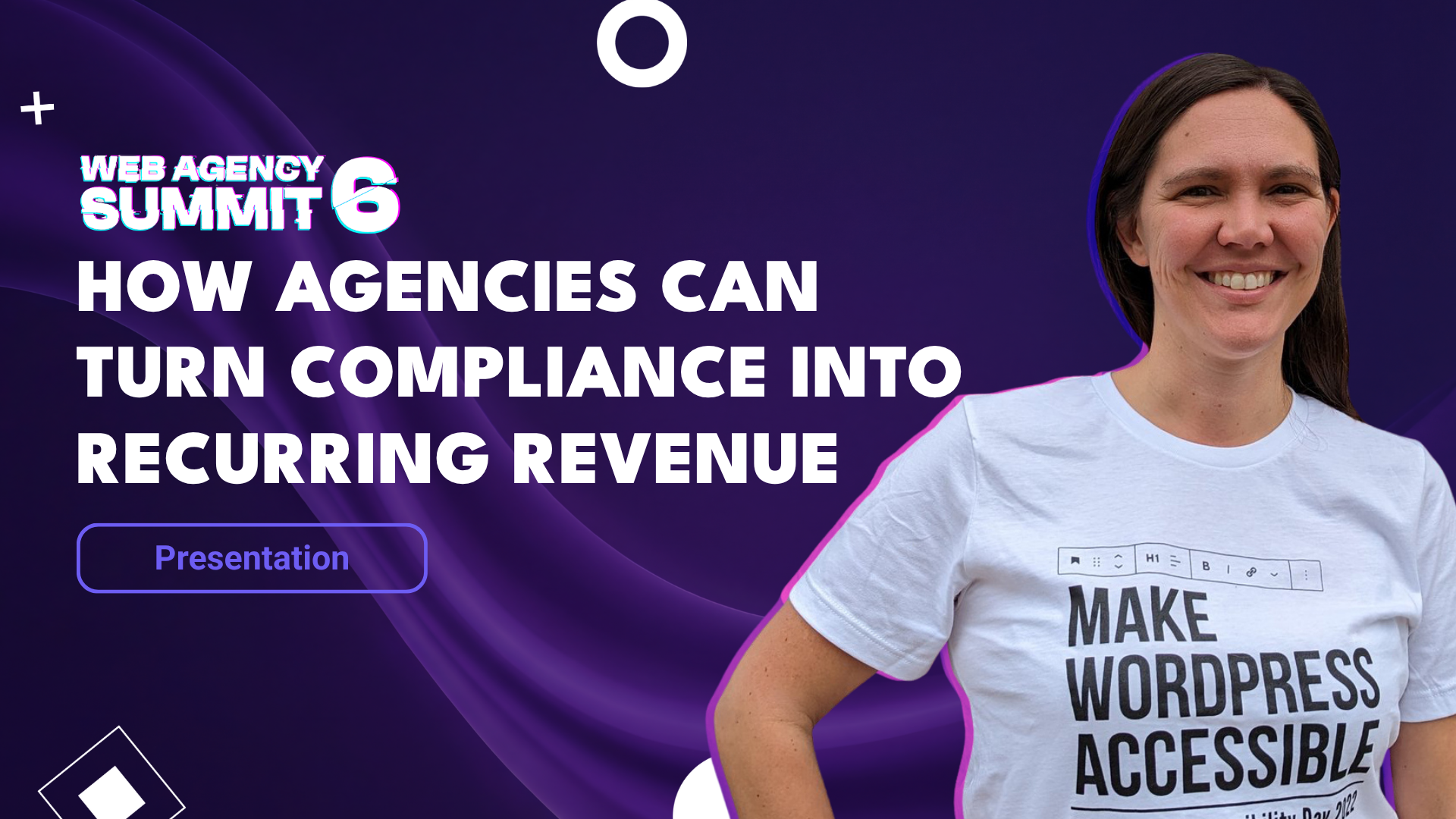
Amber Hinds, founder of Equalize Digital and a recognised voice in the WordPress accessibility space, delivered a fast-paced session on how web agencies and freelancers can build genuine, lasting recurring revenue by making website accessibility a core service offering. Drawing on her own agency's financial data from 2018 to 2024, she demonstrated that a deliberate pivot toward accessibility-focused, custom website builds drove her average project price from approximately $5,000 to nearly $70,000.
More significantly, it shifted her service revenue split from 86.5% one-off project work to 73% recurring income.
The session covered the business case for accessibility (SEO, conversions, compliance risk, operational savings), the legal landscape across the US, Canada, and Europe, how to structure recurring remediation retainer plans, how to sell those plans (and who to target), the importance of clear contract language to manage agency liability, and practical advice for agencies that are not yet accessibility experts. Amber also outlined partnership and referral opportunities through her own company, Equalize Digital, for agencies that want to offer these services without building internal expertise from scratch.
Key takeaways
- 01Recurring accessibility retainer plans shifted Equalize Digital's revenue mix from 86.5% one-off project income to 73% recurring monthly income over roughly six years.
- 02Accessibility compliance is legally required across a wide range of organisations in the US (ADA, Section 508), Canada (AODA), and Europe (European Accessibility Act), with fines reaching into the millions of euros and, in Ireland and Cyprus, even potential jail time.
- 03Long-term retainer clients are best won on positive motivations (DEI values, SEO, quality) rather than fear alone; fear-driven clients tend to want one-off emergency fixes.
- 04Recurring remediation retainers are structured around billable time increments (6, 12, 24, or 48 hours per month) and require minimum commitments of three to six months, creating predictable income for the agency.
- 05A mixed audit-and-remediation model, rather than a full audit before any fixing begins, means clients see improvements immediately, which is a powerful selling point.
- 06Documented, consistent accessibility work can help clients defend against or dismiss legal action, as demonstrated by a recent New York State ADA lawsuit that was dismissed because the website owner showed years of ongoing remediation history.
- 07Agencies do not need to be accessibility experts to start offering these services; automated scanning tools and basic keyboard testing are a practical entry point.
- 08Contract language must be precise: agencies should promise conformance with WCAG guidelines, not legal compliance, and should clearly define which pages and components are in scope.
- 09Equalize Digital offers a 15% agency discount, a 63% plugin discount for agencies managing 25 or more sites, and a 10% referral commission for 12 months to agencies that send clients their way.
What Website Accessibility Actually Is
Amber opened by briefly defining website accessibility for any attendees who were coming to the topic fresh, noting that the session would not dwell here given the tight time available. At its core, accessibility means building a website that can be used by everyone, including people with disabilities across a full range of conditions, using a variety of devices and assistive technologies such as screen readers, keyboard navigation, switch controls, and more.
The underlying mechanism is a combination of code and content optimisations. These are not cosmetic changes; they are structural improvements to the way a site is built, primarily through proper semantic HTML, correct use of ARIA attributes, clearly labelled form fields and buttons, sufficient colour contrast, and keyboard-navigable interactive elements.
The Business Benefits of Accessibility
Rather than framing accessibility purely as a compliance exercise, Amber outlined four distinct business benefits that agencies should be ready to articulate to clients. These form the positive case for investment.
Better SEO and AI Optimisation Accessibility work produces cleaner, more semantically structured HTML. This is exactly what search engine crawlers and, increasingly, AI indexing systems look for when determining what a page is about and how it should be served. Amber noted that the same underlying improvements that make a page more usable for a screen reader user also make it more understandable to a crawler, leading to better organic reach.
Increased Conversions Many accessibility improvements are also UX improvements. Labelled form fields, clearly structured navigation, and logical page flow reduce friction for all users, not just those with disabilities. The practical result is more form completions, more e-commerce checkouts, and more revenue for clients. Amber explicitly connected this to the bottom line: accessibility is not just an ethical investment, it is a commercial one.
Reduced Operational Costs When a website works well for everyone, users can self-serve more effectively. They find the information they need, complete the tasks they came to do, and leave without needing help.
That means fewer phone calls to support teams, fewer live chat interactions, and fewer support tickets. For clients running lean operations, this can represent a meaningful cost reduction over time.
Legal Compliance Accessibility laws exist in multiple jurisdictions, and non-compliance carries real financial risk. Amber positioned this as a fourth benefit alongside the others, rather than leading with it, though she acknowledged that fear of legal action is often what initially prompts clients to seek help.
The Legal Landscape
Amber gave a solid overview of the global regulatory picture, noting upfront that she is not an attorney and was not providing legal advice.
United States The Americans with Disabilities Act (ADA) is the primary instrument, and it applies far more broadly than most business owners assume. It is not limited to government websites or large corporations. For-profit businesses, non-profits, and a wide range of organisations that serve the public can all be subject to ADA requirements for their websites. Section 508 applies to federal agencies and organisations that receive federal funding.
The most common risk in the US is a civil lawsuit. When a claim is filed, the defendant typically bears both their own legal costs and the plaintiff's attorney fees, plus any settlement amount. Amber noted that demand letters and lawsuits are frequently sent without any prior complaint or request to fix the issue, which makes ongoing documented remediation efforts particularly valuable as a legal defence.
Canada
Canada has multiple pieces of accessibility legislation at the federal and provincial level. The most frequently cited example Amber gave was the Accessibility for Ontarians with Disabilities Act (AODA), which can impose fines of up to $100,000 per day for corporations and up to $50,000 per day for individuals (such as a CEO) personally found to be in violation.
These are not one-off fines; they accrue for each day the violation continues.
Europe The European Accessibility Act applies across EU member states and came into full effect for many organisations in 2025. Fines are defined at the member-state level and vary, but Amber cited examples ranging up to 5 million euros. Some jurisdictions calculate fines as a percentage of the business's revenue, which can make the penalty substantially higher for larger organisations.
Two EU member states, Ireland and Cyprus, have gone further by making deliberate non-compliance a criminal matter. If a decision-maker at an organisation is found to have refused to comply, or to have submitted false documentation to regulators, jail time is a possible consequence.
The Bigger Picture Amber's broader point was that the regulatory direction of travel is clear: accessibility requirements are expanding, enforcement is increasing, and organisations are becoming more aware of their exposure. For agencies, this is an opportunity. Clients who do not yet know about these obligations represent a pipeline of potential conversations.
Real Revenue Data: What the Pivot to Accessibility Did for Equalize Digital
Amber shared actual financial data from her agency, covering 2018 to 2024, to give attendees a concrete picture of what a deliberate focus on accessibility can do for revenue.
Average Project Price Growth In 2018, when the agency was primarily doing template-based WordPress builds and paying little attention to accessibility, the average project price was around $5,000. By 2019 it had climbed to roughly $10,000. Then came 2020 and COVID, which pushed it back down slightly to the $8,000-$9,000 range.
The inflection point came in 2021, when the agency made two deliberate decisions: to stop doing template builds and to make full custom design and development, with accessibility as a core deliverable, the standard. From that point: 2021: just under $30,000 average project price 2022: just over $40,000 2023: just over $60,000 2024: just under $70,000 By 2024, individual projects ranged from a $130,000 build at the high end to smaller scoped projects that brought the average down. Amber noted that the reduction in volume (fewer but larger projects) also significantly reduced the operational stress of running the agency, moving away from the constant churn of many small projects.
The Recurring Revenue Transformation Amber then presented two pie charts comparing the split between one-off project revenue and recurring service revenue in 2018 versus 2024.
In 2018, recurring revenue from services was 13.5% of total service revenue. The remaining 86.5% came from one-off project fees. That recurring revenue consisted mainly of basic hosting and simple maintenance plans with plugin updates and a few pre-paid support hours.
By 2024 (referred to in the session as "last year"), that split had essentially inverted: 73% of service revenue was recurring, and only 26.9% was coming from one-off project work. The mechanism that drove this transformation was the creation of structured recurring accessibility remediation plans.
The Recurring Accessibility Retainer Model
How the Plans Are Structured Equalize Digital offers four main remediation tiers, plus a monitoring-only tier. The planning logic behind the tiers is rooted in operational capacity: the team operates on the assumption that a team member can deliver six billable hours per day, with two hours reserved for meetings, project management, and internal tasks.
Because of this, all tiers are structured around increments of six hours: 6 hours per month (the entry-level tier) 12 hours per month 24 hours per month 48 hours per month Hours within each tier are generally split 50/50 between auditing and remediation (three hours each in the case of the 6-hour plan, for example), though Amber noted they apply flexibility in practice. She gave the example of a current client on the 24-hour plan whose audit of just two pages uncovered so many issues that the next two months will be entirely remediation with no further auditing, simply because there is enough identified work to fill the time.
Strategy calls are built into the plans. Pricing is publicly available on the Equalize Digital website under Services > Remediation.
Minimum Commitment Terms Clients on the 6-hour plan must commit to a minimum of six months. Clients on higher tiers commit to a minimum of three months. These minimums are written into contracts, meaning that if a client wishes to cancel early, they owe the remaining balance. Amber noted that in practice most clients continue well beyond their minimum term because the work genuinely takes that long to do properly.
This structure is central to creating the predictable monthly income that makes the model valuable for the agency.
The Audit-Then-Fix Versus Integrated Model A conventional approach to accessibility remediation is to conduct a full audit first, identify all issues across a representative sample of pages, deliver a report, and then begin fixing.
Amber argued that the integrated model used in these retainers is superior for clients.
Rather than waiting weeks or months for a complete audit, the team audits a component (say, the site header), identifies issues, hands those off to developers to fix, and continues auditing the next component in parallel. The client starts receiving improvements immediately, not after a lengthy audit phase.
Legal Protection Through Documented Ongoing Work Amber raised an important point about how these retainers can provide legal protection. A recent ADA lawsuit in New York State was dismissed because the website owner was able to demonstrate a documented history of ongoing accessibility work dating back to 2004. They showed the judge what the site looked like when it started, what had been done every month since, and what their process was for handling reported issues. The judge found no basis for the complaint, particularly given that the plaintiff had never contacted the organisation to report the problem before filing.
For clients anxious about legal exposure, this is a compelling argument: the existence of a formal, ongoing retainer with an accessibility partner creates an evidentiary record that demonstrates good faith effort.
How to Sell Accessibility Plans
Lead with Benefits, Not Just Fear Amber made a distinction that shapes who becomes a long-term client. Fear of legal consequences can bring clients in the door, but it tends to produce short-term, minimum-viable-effort engagements. Clients who arrive in panic mode after a lawsuit or a demand letter typically want an emergency fix and then they are done. They are less likely to commit to a long-term retainer.
The clients who stay on retainer for 12 months, two years, or longer tend to be the ones who care about accessibility for positive reasons, not reactive ones.
Target Clients Most Likely to Commit Amber identified several profiles of clients who are strong candidates for recurring accessibility plans: DEI-focused organisations. Businesses that have genuine commitments to diversity, equity, and inclusion understand why accessibility matters and see it as consistent with their values, regardless of any legal threat.
Organisations that value SEO, code quality, and technical performance.
Accessibility improvements overlap substantially with what drives better technical SEO scores, including Google PageSpeed performance. Enterprise clients who care about these metrics will understand the investment.
Government and higher education clients. State and local government bodies, public libraries, community colleges, and universities all operate under specific legal accessibility obligations. They are often the easiest sell because they already know compliance is required. Amber noted a particular uptick in public library clients in the United States.
Larger organisations with complex websites. Enterprises with a large number of pages, multiple content authors, and ongoing publishing activity will always have new accessibility issues emerging, making an ongoing remediation model structurally appropriate for them.
Introduce Accessibility Early in the Sales Process The most effective time to raise accessibility is in the very first discovery conversation, not partway through a project. Amber described how her business partner Chris wove accessibility into the standard discovery process by asking clients where they were located and whether they served customers in other states or countries, then asking whether they were aware of their specific accessibility or privacy compliance requirements.
This approach positions the agency as knowledgeable and thorough before the client has even engaged. Amber noted that clients frequently told her later in the relationship that her agency was the only one in the pitching process to have raised accessibility and compliance at all. That alone made clients question the competence of the other agencies they were speaking to, and it became a differentiating factor in winning the work.
Tie Accessibility to the Client's KPIs Accessibility is easiest to sell when it is connected to things the client is already measuring. If a client cares about form completions, show how accessibility improvements reduce friction for all users and increase conversions. If they care about organic search traffic, connect semantic HTML and accessible structure to better SEO. If they care about customer service costs, quantify the relationship between self-service ability and reduced support volume. The more the conversation is anchored in the client's own business goals, the more natural the investment feels.
Getting Started Without Being an Expert
Amber was explicit that agencies do not need to be accessibility specialists to begin offering these services. There are practical entry points that require no deep expertise.
Automated Scanning The Equalize Digital Accessibility Checker plugin has a free version available on WordPress.org. It scans unlimited posts and pages (as well as custom post types) with no restrictions. It surfaces many of the issues that appear in real-world lawsuits: empty links, images missing alternative text, unlabelled form fields and buttons, and other critical blockers. Running this on a client's site provides an immediate, concrete picture of problems that need addressing.
Basic Keyboard Testing Anyone can test keyboard accessibility without any specialised knowledge or tools. The method is simply to unplug or disable the mouse and navigate the site using only the keyboard: Tab moves forward through interactive elements Shift + Tab moves backward Return / Enter follows links Return / Enter and Spacebar trigger buttons Accordions, tab components, navigation menus, and form fields should all be fully operable If any interactive element cannot be reached or activated via the keyboard, that is a real accessibility failure. This test requires no expertise, takes minutes, and will almost always surface something worth raising with a client.
Know the Limits and Find a Partner Amber balanced the "you can start now" message with an honest acknowledgement of where the limits are. True accessibility testing goes beyond automated scanning and keyboard checks. It requires testing with screen readers (NVDA, JAWS, VoiceOver), expert-level knowledge of WCAG (Web Content Accessibility Guidelines), and in many cases strong JavaScript and front-end development skills to implement some of the required fixes.
Her advice was to find a partner. Equalize Digital itself offers: 15% agency discount on all published remediation pricing, allowing agencies to resell at the same rate while paying less 63% plugin discount on the Accessibility Checker per-site licence for agencies managing 25 or more sites (with further discounts for higher volumes) 10% referral commission for 12 months for agencies that simply refer clients to Equalize Digital rather than reselling the service directly Beyond Equalize Digital, Amber encouraged attendees to find other accessibility specialists in the WordPress community, whether for testing, development, or both.
Managing Legal Risk and Contract Language
The session closed with a question from an attendee named Jason, who raised the concern that offering accessibility services means taking on significant legal risk for compliance.
Amber addressed this directly.
The key principle, as advised to Amber by her own attorneys, is to be precise about what you are and are not promising. Equalize Digital's agreements commit to helping clients conform
to WCAG (Web Content Accessibility Guidelines), the technical standard that most laws reference. They never promise that a client is legally compliant with any specific law. That determination requires a lawyer and potentially a court, and is not something a web agency can or should claim to guarantee.
The second principle is rigorous scoping. On a new website build, for example, Equalize Digital would define exactly which components and pages are in scope for accessibility conformance: the header, the footer, specific page templates. They would not claim the entire site was compliant, because that would include years of imported blog posts and historical content over which they had no control.
Amber recommended that anyone offering these services review contract language carefully.
She mentioned that Equalize Digital has a blog post on their website specifically addressing contract language for accessibility services, and that their courses go into much greater detail on proposal language, contract wording, and how to structure the client conversation around scope and liability.
Resources Mentioned
Amber moved quickly through a list of resources available to attendees:
- Slides: available at equaldigital.com/agency-summit-26, which redirects to Google Slides.
- Coupon code "Agency Summit 26" for 15% off Equalize Digital courses, valid for approximately seven days from the time of the session.
- Equalize Digital courses on positioning and selling accessibility offers, including contract and proposal language templates, and screen reader testing courses.
- A free webinar covering Equalize Digital's full client user journey and onboarding process for recurring accessibility plans, available without registration on the Equalize Digital website.
- A selling accessibility panel discussion, available on the Equalize Digital blog without registration, from their WordPress meetup series.
- The Equalize Digital Accessibility Checker plugin: free version at WordPress.org, with a paid agency tier at a 63% discount for agencies managing 25 or more sites.
- Equalize Digital remediation pricing, publicly listed at equaldigital.com under Services > Remediation.
- Social: Amber Hinds on X at @HeyAmberHinds and on LinkedIn as Amber Hinds.
 About the speaker
Amber Hinds
Equalize Digital
About the speaker
Amber Hinds
Equalize Digital
Amber Hinds leads Equalize Digital, a company focused on WordPress accessibility. She has spent years helping agencies turn accessibility compliance into a well-structured, recurring service rather than a one-off fix.